 da Re-Fit
Non-Thermal Vein Treatment: Flebogrif and ClariVein (MOCA) — How Mechanochemical Ablation Works, and Where the Trials Put It
Laser and radiofrequency close a vein with heat. Mechanochemical ablation closes it without heat and without tumescent anaesthesia, which is why it is considered below the knee, where nerves run close to the vein. The randomised trials show some advantages and a trade-off in how long the vein stays closed. Both are set out here.
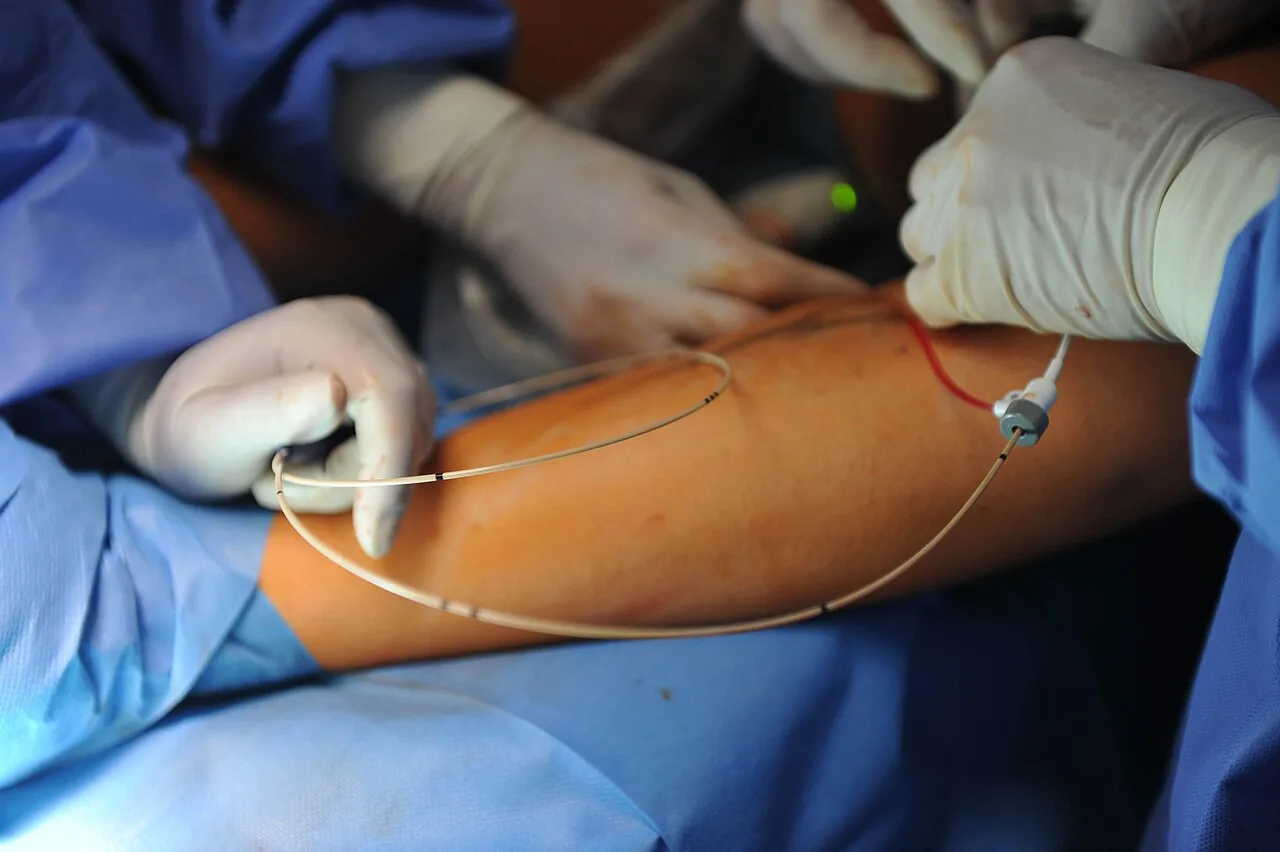
Closing a vein without heat
When people think of varicose vein treatment they usually think of laser or radiofrequency. These thermal methods, established since the early 2000s, close the refluxing vein by heating it from inside, and they remain a standard treatment.
There is also a way to close a vein without heat. A well-known example is mechanochemical ablation (MOCA), of which Flebogrif and ClariVein are the two main devices. This article explains the principle, why it was developed, and — because a new technique should be judged by its data rather than its novelty — what the randomised trials and meta-analyses comparing it with thermal ablation show.
What MOCA is
MOCA combines two things, as the name says: mechanical disruption of the vein's inner lining and a chemical sclerosant that seals it.
A fine catheter is passed into the vein. Its tip abrades the vein wall from inside while a sclerosant is delivered at the same time. No heat is involved.
ClariVein uses a rapidly rotating wire tip to abrade the wall, with liquid sclerosant infused through the catheter.
Flebogrif uses a set of small hooks that deploy from the catheter tip and scratch the wall as the catheter is withdrawn, with sclerosant delivered simultaneously (3% polidocanol foam in the Polish POLFLEB study). It is non-rotational.
Why non-thermal methods were developed
Two features of thermal ablation explain the motivation.
Tumescent anaesthesia. To protect the tissues around the vein from heat, and to anaesthetise them, thermal ablation usually involves filling the space around the vein with dilute local anaesthetic solution — roughly 200–500 mL per leg, delivered through multiple injections along the vein's course. It is a necessary step taken for the patient's safety, but the fluid can leave the leg feeling swollen, or seep from the injection sites, in the early recovery period. Non-thermal methods do not need it.
The below-knee segment. Below the knee, the great saphenous vein runs close to the saphenous nerve, and the small saphenous vein close to the sural nerve. Heat delivered there can injure them, so thermal ablation of below-knee segments is approached cautiously. Before non-thermal options existed, below-knee reflux was often left untreated after above-knee ablation, or managed with repeated sclerotherapy. MOCA was designed in part as an option for exactly these segments. The consensus statements of the 2023 SVS/AVF/AVLS guideline say the same: for reflux in the distal calf segment of a saphenous vein, non-thermal ablation is preferred, to avoid thermal nerve injury (statement 5.2.5).
What the trials of non-thermal treatment show: the advantages
Less pain during the procedure — in some studies. In an early report from a multicentre randomised trial of ClariVein against radiofrequency (Bootun et al., Phlebology, 2016; 119 patients), maximum intra-procedural pain was 19.3 mm versus 34.5 mm on a 100 mm scale, although only 66% of patients attended the one-month follow-up. A 2026 meta-analysis of MOCA against radiofrequency (Cheng et al.; 737 patients, from four randomised trials and two observational studies) reported lower perioperative pain and a return to normal activities that was on average 0.76 days faster. Not every analysis found a pain difference; that is taken up below.
Less nerve injury reported. The 2023 systematic review and meta-analysis of randomised trials comparing thermal against non-thermal ablation (Shahzad et al., European Journal of Vascular and Endovascular Surgery; 8 trials, 1,956 patients) found that non-thermal ablation caused less peri-procedural pain and carried a lower risk of nerve injury, and rated the evidence for both as moderate. This analysis compared non-thermal ablation as a whole with thermal ablation, not MOCA alone. A 2023 network meta-analysis (Bontinis et al.; 14 studies, 4,177 patients) found a higher risk of postoperative paraesthesia after laser than after MOCA (risk ratio 9.61, 95% confidence interval 2.32–62.29). The interval is very wide, so the result is better read as showing a direction than as a "ten-fold" figure — and the comparison is laser against MOCA: radiofrequency, like MOCA and adhesive, was on the lower-risk side relative to laser.
Similar quality of life. Disease-specific quality of life was reported to improve to a similar degree after MOCA and after thermal ablation: the pooled analysis found no significant difference in AVVQ score at one year (Lim et al., British Journal of Surgery, 2023), and the Helsinki trial found none at one, three or seven years. In the Bontinis network meta-analysis, however, the improvement in the physician-assessed clinical severity score (VCSS) was smaller after MOCA than after radiofrequency, laser or adhesive.
What the trials of non-thermal treatment show: the trade-off
The trade-off is durability of vein closure, and it should be stated plainly.
The Helsinki randomised trial (Vähäaho and colleagues) allocated 125 patients 2:1:1 to MOCA, laser or radiofrequency. At one year the treated great saphenous vein was fully closed in 100% of the laser and radiofrequency patients and 82% of the MOCA patients (British Journal of Surgery, 2019). At three years the figures were the same, 82% versus 100%. At seven years (2026; 89 of the 125 patients attended), reflux in the upper 20 cm of the treated vein was found in 23% after MOCA versus 7% after thermal ablation, with two MOCA patients re-operated on the treated segment between three and seven years and none in the thermal group. Quality of life did not differ at any time point.
Most of the pooled analyses point the same way. Lim's meta-analysis of four randomised trials (654 patients) found one-year anatomical occlusion lower after MOCA (risk ratio 0.85, 95% confidence interval 0.78–0.91). Bontinis's network meta-analysis found radiofrequency, adhesive and laser all had higher odds of closure than MOCA. Cheng's 2026 meta-analysis reported higher anatomical success with radiofrequency in both the short and long term.
The results do not all run in one direction, though. The primary result of the Shahzad meta-analysis, which compared thermal ablation with non-thermal ablation as a whole, was no statistically significant difference in occlusion at four weeks or at one to two years (relative risk at one to two years 0.95, 95% confidence interval 0.88–1.01). That an analysis pooling all non-thermal methods and analyses of MOCA alone give different answers suggests that results may differ from one non-thermal method to another.
Two nuances deserve mention. First, vein diameter matters: in their three-year report the Helsinki investigators found that great saphenous veins wider than 7 mm before treatment were more likely to recanalise after MOCA, and concluded that its use in large-calibre veins should be considered carefully. Second, Lim's meta-analysis found no significant difference in procedural or post-procedural pain between MOCA and thermal ablation, unlike the early trial report above. The pain advantage appears smaller than early reports suggested, and it has not been confirmed consistently from study to study.
The evidence for Flebogrif specifically
Most of the randomised evidence above comes from ClariVein. Flebogrif is newer and its evidence is at an earlier stage: what is available so far is not randomised comparison with thermal ablation but single-arm studies without a control group.
The POLFLEB prospective multicentre study (Zubilewicz et al., 2026) treated 200 patients with great saphenous veins of 4–10 mm using Flebogrif with 3% polidocanol foam. Ultrasound immediately after treatment and within seven days showed the vein occluded in every patient; at three months 95.8% of treated veins remained free of reflux; at twelve months 90.6% remained reflux-free, with complete reopening in 4.4%. No serious adverse events were reported within 30 days. The study had no control group, and some of its authors disclosed speaker activity for the manufacturer. A Korean single-centre retrospective analysis (Park & Park, 2026) of 105 great saphenous veins in 61 patients reported anatomical success of 100% at one month, 98.4% at six months and 95.4% at twelve months, and no major complications such as paraesthesia or deep vein thrombosis; it carries the limitations of retrospective data from one centre.
A randomised trial against laser has been designed in the Netherlands: the REBORN trial (310 patients, non-inferiority design, primary outcome anatomical success at twelve months), whose protocol was published in 2024. Until it reports, Flebogrif's position relative to thermal ablation rests on single-arm data, and the results of the ClariVein randomised trials above cannot simply be carried over to Flebogrif.
Where this leaves the choice between thermal and non-thermal treatment
Non-thermal ablation is not better in every case, and it is not worse in every case. Reading the evidence together:
- MOCA can be considered where avoiding tumescent anaesthesia matters, where the segment lies close to a nerve — particularly below the knee — and in smaller-calibre veins.
- Closure was reported to hold better after thermal ablation in large-diameter great saphenous trunks. The 2023 SVS/AVF/AVLS consensus statements likewise suggest thermal ablation (laser or radiofrequency) rather than non-thermal ablation for large, non-aneurysmal saphenous veins over 10 mm (statement 5.2.7).
- Disease-specific quality of life did not differ between the two approaches in the comparative studies, which means the recanalisation seen on ultrasound did not translate directly into a difference patients felt. In the Helsinki seven-year follow-up, however, recurrent reflux and further treatment were more frequent after MOCA.
- Cochrane's 2021 review found no clear difference between radiofrequency and MOCA in technical success or recurrence, but rated the evidence low-certainty and noted that long-term data were not available. The Helsinki seven-year data have since filled part of that gap.
Which method suits a particular leg depends on the vein's location, diameter and condition, and on what matters most to the patient. It is decided from the duplex ultrasound, not from a preference for the newest device — a principle we have written about elsewhere.
References
- Bootun R, Lane TR, Dharmarajah B, et al. Intra-procedural pain score in a randomised controlled trial comparing mechanochemical ablation to radiofrequency ablation: The Multicentre Venefit versus ClariVein for varicose veins trial. Phlebology. 2016;31(1):61-5. (PMID: 25193822)
- Vähäaho S, Mahmoud O, Halmesmäki K, et al. Randomized clinical trial of mechanochemical and endovenous thermal ablation of great saphenous varicose veins. Br J Surg. 2019;106(5):548-554. (PMID: 30908611)
- Vähäaho S, Halmesmäki K, Mahmoud O, et al. Three-year results of a randomized controlled trial comparing mechanochemical and thermal ablation in the treatment of insufficient great saphenous veins. J Vasc Surg Venous Lymphat Disord. 2021;9(3):652-659. (PMID: 32795619)
- Hurmerinta-Kurkijärvi OL, Weselius EJ, Vähäaho SM, et al. Randomised Trial of Mechanochemical or Thermal Ablation for Great Saphenous Vein Insufficiency: 7 Year Follow Up. Eur J Vasc Endovasc Surg. 2026. (PMID: 42401285)
- Lim AJM, Mohamed AH, Hitchman LH, et al. Clinical outcomes following mechanochemical ablation of superficial venous incompetence compared with endothermal ablation: meta-analysis. Br J Surg. 2023;110(5):562-567. (PMID: 36894167)
- Shahzad N, Elsherif M, Obaidat I, et al. A Systematic Review and Meta-Analysis of Randomised Controlled Trials Comparing Thermal Versus Non-Thermal Endovenous Ablation in Superficial Venous Incompetence. Eur J Vasc Endovasc Surg. 2023;66(5):687-695. (PMID: 37295602)
- Bontinis V, Bontinis A, Koutsoumpelis A, et al. A network meta-analysis on the efficacy and safety of thermal and nonthermal endovenous ablation treatments. J Vasc Surg Venous Lymphat Disord. 2023;11(4):854-865.e5. (PMID: 37030442)
- Cheng Q, Zhao Q, Cao J, et al. Comparing the Efficacy of Mechanochemical Ablation Versus Radiofrequency Ablation for Treating Great Saphenous Vein Incompetence: A Meta-Analysis. Ann Vasc Surg. 2026;132:622-635. (PMID: 42468801)
- Zubilewicz T, Urbanek T, Janczak D, et al. The prospective multicenter study assessing safety and efficacy of mechanochemical ablation with the use of the Flebogrif catheter in patients with great saphenous vein incompetence: One year results. J Vasc Surg Venous Lymphat Disord. 2026:102584. (PMID: 42532411)
- Park I, Park S. One-year outcomes of mechanochemical ablation of incompetent saphenous veins using the Flebogrif device. J Vasc Surg Venous Lymphat Disord. 2026;14(1):102345. (PMID: 41135794)
- Oud S, Alozai T, Schreve MA, et al. Comparing mechanochemical endovenous ablation using Flebogrif with endovenous laser ablation in the treatment of primary great saphenous vein incompetence: protocol for a multicentre, open-label, non-inferiority, observer-blinded, randomised controlled trial (REBORN trial). BMJ Open. 2024;14(8):e087490. (PMID: 39117408)
- Whing J, Nandhra S, Nesbitt C, Stansby G. Interventions for great saphenous vein incompetence. Cochrane Database Syst Rev. 2021;8(8):CD005624. (PMID: 34378180)
- Gloviczki P, Lawrence PF, Wasan SM, et al. The 2023 Society for Vascular Surgery, American Venous Forum, and American Vein and Lymphatic Society clinical practice guidelines for the management of varicose veins of the lower extremities. Part II. J Vasc Surg Venous Lymphat Disord. 2024;12(1):101670. (PMID: 37652254)
Frequently asked questions
- How does mechanochemical ablation (MOCA) close a varicose vein without heat?
- A fine catheter is passed into the vein. Its tip abrades the vein wall from inside while a sclerosant is delivered at the same time. No heat is involved.
- Why is non-thermal ablation such as MOCA considered for varicose veins below the knee?
- Below the knee, the great saphenous vein runs close to the saphenous nerve, and the small saphenous vein close to the sural nerve. Heat delivered there can injure them, so thermal ablation of below-knee segments is approached cautiously.
- How did vein closure after MOCA compare with laser and radiofrequency ablation in a randomised trial?
- The Helsinki randomised trial (Vähäaho and colleagues) allocated 125 patients 2:1:1 to MOCA, laser or radiofrequency. At one year the treated great saphenous vein was fully closed in 100% of the laser and radiofrequency patients and 82% of the MOCA patients (British Journal of Surgery, 2019).
- How do the ClariVein and Flebogrif MOCA devices work?
- ClariVein uses a rapidly rotating wire tip to abrade the wall, with liquid sclerosant infused through the catheter. Flebogrif uses a set of small hooks that deploy from the catheter tip and scratch the wall as the catheter is withdrawn, with sclerosant delivered simultaneously (3% polidocanol foam in the Polish POLFLEB study).
- How is the choice between MOCA and thermal ablation made for varicose veins?
- Which method suits a particular leg depends on the vein's location, diameter and condition, and on what matters most to the patient.

Don't navigate your leg symptoms alone
From precise duplex ultrasound diagnosis to treatment — consult directly with board-certified surgeons trained at Asan Medical Center.
Language support is available through our interpretation system.