 da Re-Fit
1064nm Laser for Leg Telangiectasia
Long-pulsed Nd:YAG protocol (VARITON-S)
Leg Spider Veins Are Not Only a Cosmetic Concern
When fine red or blue vessels become visible on the legs, they are usually thought of as an appearance issue. In practice, many patients with these vessels also experience localized pain, burning, and a sense of heaviness in the affected area.
There is a reason for this. The fine vessels visible through the skin connect to reticular veins beneath them. When those deeper veins reflux, they transmit elevated pressure to the thin superficial vessels, which dilate persistently. Sensory nerves surrounding these vessels are irritated in the process, producing stinging or burning sensations.
One feature distinguishes leg telangiectasia from facial vessels: symptoms are typically worse after prolonged standing, because the legs bear the direct effect of gravity.
“It’s Just Cosmetic” — A Common Response
Patients who seek care for leg spider veins often hear some version of the following:
- “That’s not a vein problem — it’s cosmetic.”
- “Legs are different from the face; laser treatment there is difficult.”
- “It’s not severe enough to treat.”
Symptoms are present, yet no clear answer follows. The reason is that these vessels fall at the boundary between clinical territories.
In dermatologic practice, leg vessels are approached cautiously because they sit deeper and carry higher pressure than facial vessels. In phlebology, treatment centers on reflux in the large veins, and the finest vessels rank lower in priority. Neither field treats this as its central concern.
The result is that patients with genuine symptoms leave without a full explanation. Pain is classified as cosmetic; a request for treatment is met with reassurance that nothing needs to be done.
This is why da Re-Fit Clinic treats this territory as a formal clinical concern and has developed a protocol for it — from wavelength selection through treatment parameters. We regard telangiectasia as one stage of venous disease, not as something outside the scope of care.
Why Legs Cannot Be Treated Like the Face
Vascular lasers come in several wavelengths, each reaching a different depth and absorbed by different targets.
532nmsurface, under 0.5mm
Acts near the skin surface. Well suited to superficial facial vessels, but strongly absorbed by melanin, which limits its use on leg vessels in Asian skin.
595nmintermediate, 0.5–1.0mm
Reaches intermediate depth.
1064nmdeeper dermis, 1.5–3.0mm
Penetrates into the deeper dermis with comparatively low melanin absorption.
Leg vessels lie deeper than facial vessels, and Asian skin carries relatively more melanin. Considered together, these two conditions make 1064nm the appropriate wavelength for treating leg vessels in Asian patients.
Wavelength Alone Is Not Enough
Results differ even with the same 1064nm device, depending on how it is configured. Vessel diameter and depth, skin tone, and the condition of the skin on the day of treatment all require adjustment in energy and delivery.
Based on clinical experience, da Re-Fit Clinic has developed and follows its own protocol governing energy settings, pulse delivery, cooling management, and treatment intervals. This protocol formed the core of our presentation at the Asian Venous Forum 2026.
Our position is that outcomes are determined not by the device but by how it is used. Specific parameters are determined after examining each patient’s vessels and are explained during consultation.
Who This Treatment May Suit
Generally appropriate for
- Fine telangiectasia and spider veins (typically under 1.0mm)
- Connected reticular veins beneath them
- Patients for whom injection-based treatment is difficult, or who have experienced hyperpigmentation after prior sclerotherapy
- Patients with visible vessels accompanied by burning or pain
Requires caution, or another treatment first
- Significantly tanned skin — treated with reduced energy and enhanced cooling
- Saphenous reflux present — the source vein is treated first
- Pregnancy, photosensitizing medications, or a tendency toward keloid formation
What Treatment Involves
| Session length | 5–30 minutes, depending on the area treated |
|---|---|
| Number of sessions | Typically around 3 (varies by individual) |
| Interval | 6–8 weeks |
| Anesthesia | Usually none; nitrous oxide inhalation sedation is available, and sedation may be considered for extensive treatment |
| After treatment | Sun protection required |
Aftercare
Temporary hyperpigmentation may appear following treatment. This is part of the process by which coagulated vessels are reabsorbed, and it generally fades over time.
What we provide
Oral tranexamic acid and glutathione are prescribed to reduce pigmentation response. Duration is advised according to the treated area and your progress.
What you should do
Sun protection is the single most important step. Ultraviolet exposure on treated areas can deepen or prolong pigmentation. For 4–6 weeks after treatment, apply sunscreen or cover the area during outdoor activity.
Beyond this, there are no special restrictions on daily activity.
Academic Background
This protocol was presented as an invited oral lecture at the Asian Venous Forum 2026 in Fukushima, Japan.
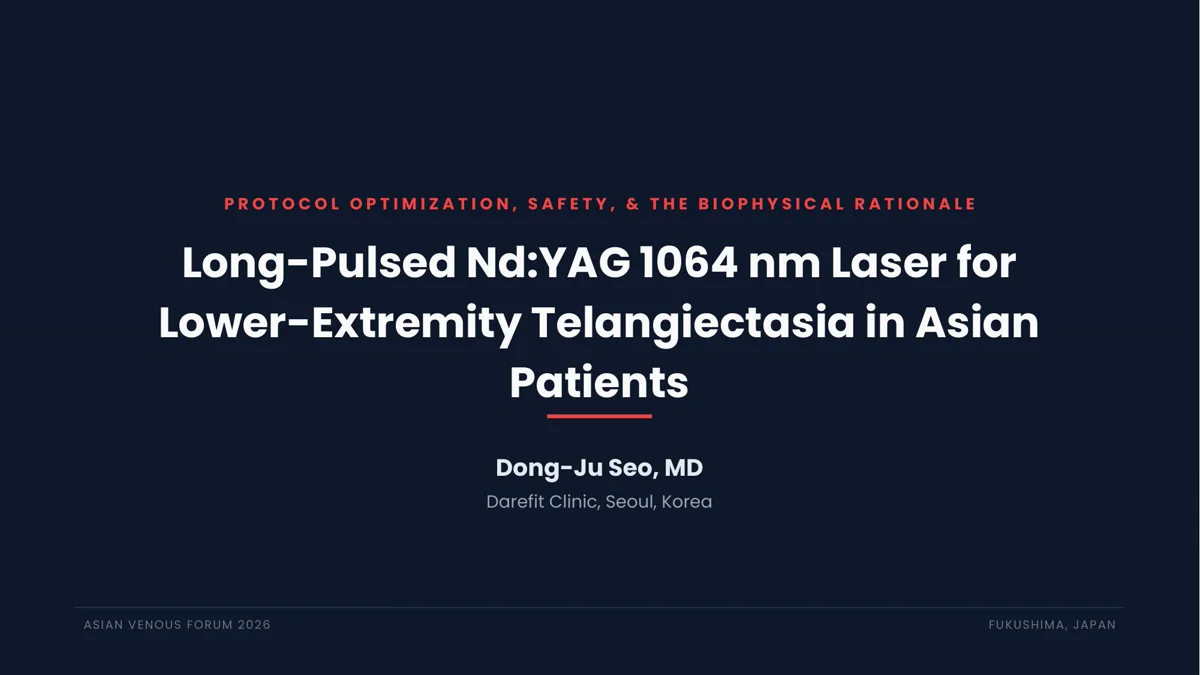
Long-Pulsed Nd:YAG 1064 nm Laser for Lower-Extremity Telangiectasia in Asian Patients
— Protocol Optimization, Safety, & the Biophysical RationaleDong-Ju Seo, MD · da Re-Fit Clinic, Seoul, Korea
Asian Venous Forum 2026, Fukushima, Japan
The presentation addressed the conditions required to use 1064nm safely in Asian skin, the rationale for pulse settings relative to vessel diameter, and the protocol developed in clinical practice.
This represents a single-center clinical experience rather than a randomized controlled trial, and long-term follow-up beyond 12 months has not yet been compiled. Outcomes vary by skin tone and by the depth and diameter of the vessels treated.
Consultation
If visible vessels on your legs concern you — or if they are accompanied by discomfort — an examination can clarify what is involved. We assess vessel depth and diameter by ultrasound, determine whether a source vein is contributing, and then advise on the appropriate approach.
Consultations are available in English.

Don't navigate your leg symptoms alone
From precise duplex ultrasound diagnosis to treatment — consult directly with board-certified surgeons trained at Asan Medical Center.
Ask About Your Treatment