 da Re-Fit Clinic
The reasons a waistline remains unchanged after weight loss vary. Fat, abdominal muscle tone and posture, skin elasticity, and the shape of the pelvis and lower rib cage all contribute. A wide-looking lower rib cage alone does not mean rib remodeling is needed.
Four factors that shape the waist
The following factors work together to shape the waist:
- The amount and distribution of subcutaneous fat
- Abdominal muscle tone and posture
- Skin elasticity and laxity
- The width and angle of the pelvis and lower rib cage
This explains why people of the same height and weight can have different waist shapes. Fat may be the main cause, while skin or abdominal-wall changes may matter more in others. If the upper waist looks wide despite little body fat, the lower rib-cage structure may also be contributing.
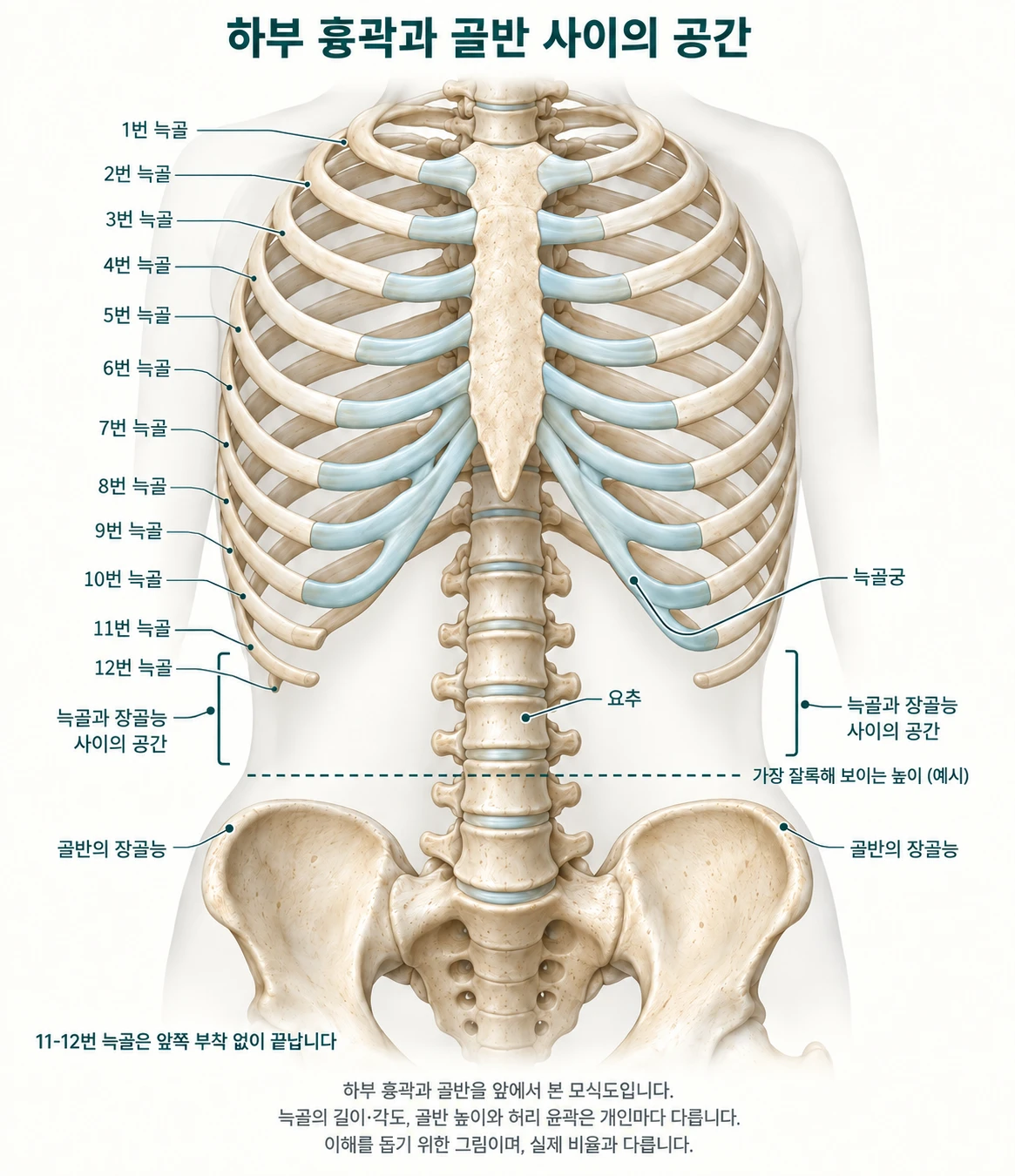
The narrowest-looking waist is often at the level where the ribs end
The upper ribs attach to the sternum at the front, forming a closed cage. Lower down, the situation changes. Rib 10 connects indirectly through cartilage, while ribs 11 and 12 end without an anterior attachment. Floating ribs are the name for these structures.
The narrowest-looking part of the waist is often at this level. If this region is wide or the ribs flare outward, thinning the fat layer can make the underlying bone contour more apparent. This may explain why someone with a slim build still feels that their upper waist looks wide.
What weight loss changes—and what remains
Weight loss is the basic approach to reducing abdominal and flank fat. Exercise helps improve abdominal-wall function and posture, supporting overall body contour.
In particular, visceral fat is not removed by this operation. If the whole abdomen protrudes and feels firm, weight management comes before liposuction or rib surgery. In such cases, weight loss alone can noticeably reduce waist circumference.
Reducing fat does not also change skeletal width and angles. If weight has already been substantially reduced but the line from the lower ribs to the waist remains nearly straight, further weight loss alone may not create the desired curve.
Liposuction and rib remodeling have different aims
Liposuction reduces the layer of subcutaneous fat beneath the skin. It may suit cases where fat makes the flanks thick or obscures the waist. It does not treat obesity or replace exercise.
Rib remodeling does not remove fat. Some methods aim to change the skeletal contour of the upper waist by adjusting the angle and position of the lower ribs without removing them.
Neither treatment is inherently the better option. The approach should depend on whether the main issue is fat, skin and the abdominal wall, or rib-cage structure. One treatment may be sufficient; when several factors contribute, a combined plan may be considered.
What research shows, and what remains unknown
In 2025 Aesthetic Plastic Surgery, a systematic review and meta-analysis published online examined rib remodeling without rib removal, bringing together 4 studies involving 318 patients. These included two ultrasound-guided studies (30 and 100 patients), one open-incision study (57 patients) and one ultrasound-assisted study (131 patients).1
- The pooled analysis found an average waist-circumference reduction of 8.6 cm at 3 months compared with baseline (4 studies; 95% confidence interval 6.9–10.3 cm)
- Patient satisfaction was reported as 94.9 per 100 patients
- No pneumothorax or hemothorax was reported; skin burns occurred at 0.57 per 100 patients and asymmetry at 1.85 per 100
The limitations are clear. Women made up 98% of participants, with a mean age of 32.7 years and mean BMI of 22.4: predominantly young, relatively slim people. Waist circumference was compared at 3 months, while the included studies had maximum follow-up periods of 3–12 months. The authors also noted the absence of long-term follow-up.
None of the four studies had a control group, and most involved other operations at the same time. The authors stated that procedures such as liposuction or abdominoplasty may have independently contributed to the waist reduction. One co-author developed the ultrasound-guided method, RibXcar, and this was disclosed as a conflict of interest.
These findings do not justify expecting the same result in every body type or concluding that long-term safety is established. Although this analysis reported no pneumothorax, another study following 3,805 patients for one year reported 4 pneumothoraces and 1 hemothorax.2 The possibility cannot be ruled out.
The rib cage must be treated with attention to what it protects
The rib cage is close to the lungs, pleura, intercostal nerves and vessels. Pain, asymmetry, sensory changes and problems with bone union must be considered, as must rare complications such as pneumothorax. Corrective equipment may need to be worn for a period after surgery, along with adherence to the prescribed recovery plan.
A decision about surgery should therefore consider the following together, rather than waist circumference alone:
- Current weight and recent weight changes (ongoing weight loss makes outcomes difficult to predict)
- Thickness and distribution of subcutaneous fat
- Skin elasticity and abdominal-wall condition
- Proportions of the lower rib cage and pelvis
- The extent and realism of the desired change
- Surgical risk factors and ability to follow recovery instructions
Identify the cause before choosing an operation
An unchanged waistline after weight loss does not necessarily mean the rib cage is responsible. Equally, it is inappropriate to attribute every issue to fat and repeatedly recommend further weight loss or fat removal.
The priority is to identify which structures chiefly create the current waistline, rather than choosing an operation first. Fat, skin and abdominal-wall problems each call for an appropriate approach. If skeletal contour remains the main concern after adequate weight management, the possibilities and limitations of rib remodeling can then be discussed.
Good body-contouring decisions begin by distinguishing what can be changed from what should not be changed, rather than aiming to change as much as possible.
References
- Milani-Reis A, Roca Mora MM, Bicudo Bregion P, et al. Rib Remodeling Without Rib Resection: A Systematic Review and Meta-analysis. Aesthetic Plast Surg. 2026;50(2):667–674 (published online September 2025). doi:10.1007/s00266-025-05240-w
- Manzaneda Cipriani RM, Duran H, Adrianzen GA, et al. A Multicenter Cohort Study of 3805 RibXcar Cases: Safety and Efficacy in Incisionless Rib Remodeling. Plast Reconstr Surg Glob Open. 2026;14(7):e7929. doi:10.1097/GOX.0000000000007929
Rib remodeling is an elective cosmetic operation. Suitability and outcomes vary with individual anatomy and health. A decision should follow examination, testing and a thorough discussion with the medical team.
→ More on rib-cage anatomy
→ Possible complications
→ When the procedure is not recommended