 da Re-Fit Clinic
Thoracic Surgery
A surgeon trained in chest-wall surgery
works with the rib cage.
Dr. Dongju Seo · Board-certified cardiothoracic surgeon · Member, Korean Society for Thoracic and Cardiovascular Surgery
da Re-Fit Clinic · Gangnam, Seoul
Rib remodeling changes the angle of the lower ribs to reshape the skeletal contour of the upper waist. It is not an operation to remove fat.
We first assess whether your waist contour is mainly influenced by fat, the skin and abdominal wall, or the underlying skeleton. If consultation and examinations indicate that the operation is unsuitable, we do not proceed with surgery.
The overview below focuses on RIBXCAR. The comparison of the two methods explains how RIBOSS differs and what informs the choice. Choosing RIBOSS or RIBXCAR →
The lower ribs are kept; their angles are changed.
The upper-waist contour depends not only on fat but also on the width and angle of the lower ribs. Rib remodeling changes the angle of those ribs.
- Target ribs Mainly ribs 10–12, with rib 9 included when needed.
- Method Only the outer cortex at the back of the rib is divided. The rib is bent inward while the inner cortex stays connected. This is an incomplete, or greenstick, fracture; the bone does not separate into two pieces.
- Assessment A fine instrument is inserted through the skin instead of an incision, and each stage is checked with ultrasound.
- Preoperative tests 3D chest CT assesses rib number, length and cartilage connections. It is required before surgery.
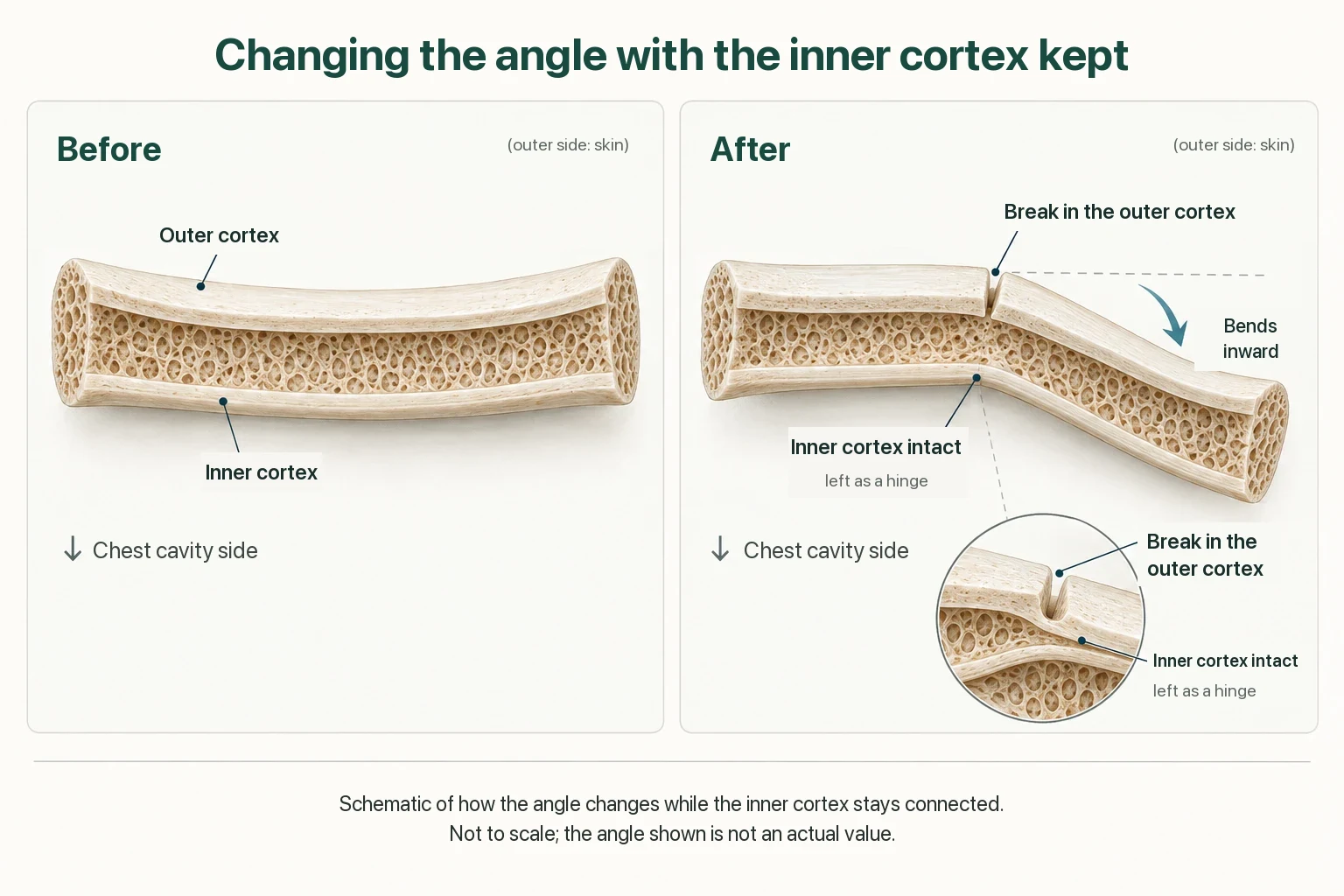
An incomplete fracture is still a fracture. Bone healing takes months, during which a binder is worn.
This website explains chest-wall anatomy, the origins of the operation, what can go wrong and who should not have it. It is designed to help you read and make an informed judgment.
How the angle is changed →
Why 3D CT is taken before surgery →
RIBXCAR
RIBXCAR is the name of this surgical method.
Rib remodeling can be performed in several ways. RIBXCAR names the method performed without an incision and checked with ultrasound. da Re-Fit Clinic offers both RIBOSS with titanium plate fixation and RIBXCAR, selecting the approach according to the individual patient.
It differs in principle from rib resection, which cuts ribs away. Keeping the ribs does not mean that their preoperative structure and function remain entirely unchanged.
How it works
Changing the angle of the lower ribs by dividing only the outer cortex while preserving the inner connection.
Published research
From the first report to multicenter cohorts and lung-function studies: participants, findings and limitations in a table.
Frequently asked questions
Twelve questions and answers on rib resection, breathing, binders and recovery.
RIBXCAR
RIBOSS and RIBXCAR: a choice tailored to the patient
Both methods retain the ribs and adjust their angle, but differ in access and fixation. da Re-Fit Clinic offers both RIBOSS and RIBXCAR, selecting an approach around the patient’s chest-wall anatomy, desired change and recovery plan.
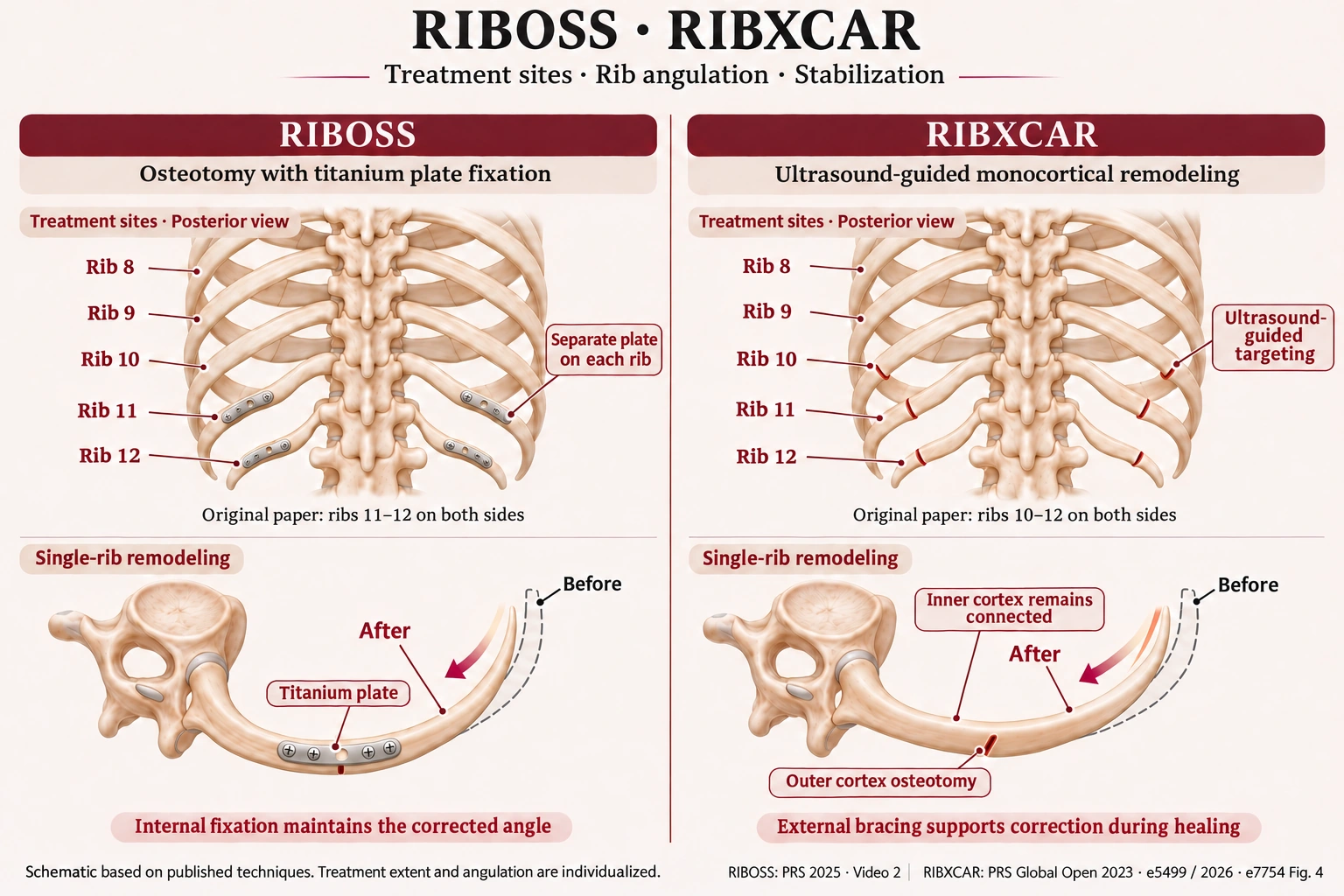
The diagram shows inward rib angulation and the difference between internal plate fixation and support from an external brace.
Rib numbers reflect the original papers. The extent and angle of correction are tailored to each patient.
View larger diagramDiagram references: RIBOSS · 2025 · Video 2 · RIBXCAR · 2023 · RIBXCAR · 2026 · Fig. 4
| What to consider | RIBOSS · Titanium plate fixation | RIBXCAR · Ultrasound-guided percutaneous remodeling |
|---|---|---|
| How the rib is treated | The rib is retained. A limited osteotomy changes its angle, which is then secured with a titanium plate and screws. | Under ultrasound guidance, one cortex is divided and the angle adjusted while retaining the connection on the opposite side. |
| Access and scars | A skin incision is needed to reach the rib and position the plate. The resulting scar is part of the discussion. | Instruments enter through skin punctures. Even small access sites can sustain skin injury or leave scars. |
| Maintaining the corrected angle | An implanted plate provides internal fixation, reducing reliance on a corset for bone stabilization. Compression garments for any combined procedures are planned separately. | No metal plate is implanted. An external brace is an important part of care while the bone heals. How and how long to wear it is individually advised. |
| What to monitor during recovery | The incision, implant-related discomfort, pain and bone healing are assessed. The implications of leaving fixation hardware in the body are discussed. | Brace use, pressure on the skin, pain, maintenance of correction and bone healing are assessed. Discuss whether the care plan fits daily life. |
Advantages and considerations
| What to consider | RIBOSS · Titanium plate fixation | RIBXCAR · Ultrasound-guided percutaneous remodeling |
|---|---|---|
| Advantages | Internal plate fixation can reduce reliance on an external brace for bone stabilization. | Access is through small skin punctures, without implanting a metal plate. |
| Disadvantages and burdens | Skin incisions, scars and the presence of metal fixation hardware in the body need to be considered. Compression garments may still be needed for combined procedures. | Brace use and activity management are important. Even small access sites can develop skin injury, burns or scars. |
An advantage of a procedure may not be an advantage for you.
We plan treatment and recovery together, considering your chest-wall anatomy, desired changes, views on scars and implants, and how brace use would fit your daily life.
Which approach might suit me?
- Chest-wall anatomy and healthRib shape, bone quality, surrounding tissues, respiratory conditions and previous surgery are assessed. One finding does not determine the technique; surgery itself may be unsuitable.
- Desired change and acceptable burdensDiscuss the area and extent of correction, your views on incision scars and metal implants, and the burden of wearing a brace.
- Recovery and everyday lifeWork, activity, combined procedures, brace care and access to follow-up are considered. Recovery planning is individualized alongside the operation.
At da Re-Fit Clinic, we consider your chest-wall anatomy and goals alongside wounds, discomfort and the return to daily life. During consultation, we explain each method’s advantages, burdens and individual risks, then agree on an operation and recovery plan suited to you.
Both are operations on the ribs. Risks including pain, bleeding, infection, pneumothorax, hemothorax and asymmetry must be considered, along with individual differences in recovery.
Scars, braces and recovery: common questions
At da Re-Fit Clinic, we plan for wound care, comfort and your return to daily life. These are the principles we use to guide patients through scar care, brace use and recovery.
How do scars differ between RIBOSS and RIBXCAR?
Before surgery, we explain the expected location and extent of wounds and how to care for them during recovery. RIBOSS requires a skin incision to position the plate; RIBXCAR uses small skin punctures. Even small access sites can develop skin injury, burns or scars, so we assess the wounds after surgery and guide your care accordingly.
Does RIBOSS mean I will not need a brace or compression garment?
RIBOSS fixes the ribs internally with plates. We distinguish a brace for bone stabilization from compression garments needed for combined procedures such as liposuction. We review the extent of your operation and any combined procedures, then advise whether support is needed and for how long.
How long is a brace worn after RIBXCAR?
We tailor brace wear time and pressure to the extent of surgery and bone healing. We explain how to wear it and what to consider in daily life, adjusting the plan as recovery progresses. If you develop pressure-related skin discomfort or pain, contact the clinic instead of enduring it or tightening the brace further. We also confirm together when to reduce or stop wearing it.
How many days after surgery can I return to work or daily life?
At consultation, we ask about your work, usual activity and preferred return date to plan your recovery. Desk work and heavy lifting require different levels of recovery. After surgery, we assess pain, wounds, breathing, combined procedures and practical brace use before advising when to return.
When can I resume exercise or strenuous activity?
We guide a gradual return, distinguishing light daily activity from strenuous exercise. We advise resuming heavy lifting or exercises that strongly engage the trunk after assessing the surgical site and bone healing. We consider more than pain relief alone and adjust activity type and intensity to your operation and progress.
Is recovery faster with RIBOSS or RIBXCAR?
Recovery time depends on the extent of surgery, combined procedures, health and daily circumstances. We consider the recovery demands of the incision and implants with RIBOSS and brace use with RIBXCAR. We listen to your concerns and return-to-activity goals, then agree on a suitable operation and care plan.
Sources for the technique descriptions
- Aguilar Villa et al. Aesthetic Rib Cage Remodeling with Osteosynthesis. Plast Reconstr Surg. 2025;155:279–288.
- Manzaneda Cipriani et al. Waist Remodeling without Incision, with Ultrasound-guided Monocortical Fracture. PRS Global Open. 2023;11:e5499.
- Ramírez Donders and Ramirez Saenz. Waist Remodeling Without Incision, With Ultrasound-guided Monocortical Fracture: Report of 220 Patients. PRS Global Open. 2025;13:e6595.
and Limitations
The rib angle changes. Results cannot be promised.
The purpose is to change the angle of the lower ribs. Published studies report changes in rib angle and waist circumference after surgery. Study figures are averages; figures and sources are provided in the articles.
Limitations of the evidence
- Results vary between people Results depend on rib anatomy, binder use and body type. Not everyone has the same outcome.
- There were no control groups None of the four studies in the meta-analysis had a control group, and most patients also had procedures such as liposuction. Those additional procedures may have contributed independently to waist reduction.
- Long-term follow-up is limited The studies in the same meta-analysis had maximum follow-up periods of 3–12 months, and the authors noted the lack of long-term data.
- There are things CT cannot tell us CT shows anatomy, but cannot predict how much waist circumference will change after surgery.
When the rib cage is not the cause
An unchanged waistline after weight loss does not necessarily mean the rib cage is responsible. Fat, skin and abdominal-wall concerns each require an appropriate approach. Visceral fat is not removed by this operation.
If expectations differ from what is possible, technically successful surgery may still be disappointing. We discuss that gap during consultation.
Study findings and their limitations →
What keeping the ribs really means →
This operation is not suitable for everyone.
We publish the situations in which surgery is not recommended or careful consultation is needed. If any applies, surgery may be advised against or further tests requested first.
- Osteoporosis, osteopenia or other metabolic bone disease
- History of rib fracture
- Asthma, COPD or other respiratory disease
- Connective-tissue disease, including Marfan and Ehlers–Danlos syndromes
- Chest-wall deformities that have not been assessed, including pectus excavatum and pectus carinatum
- Long-term steroid use
- Pregnancy, breastfeeding or plans for pregnancy soon
- Difficulty attending scheduled follow-up
Pectus excavatum and pectus carinatum are congenital chest-wall deformities, and assessment as a chest-wall deformity comes first. Only where the angle of the lower ribs remains a concern after that assessment do we judge separately whether rib remodeling can be applied.
What we assess in consultation
- Whether fat, lower-rib angles or anterior costal cartilage create the contour
- Rib number, length and cartilage connections on CT
- Which areas can be changed and which should be left as they are
- Whether I can adhere to binder use and follow-up appointments
Things to understand first.
Rib remodeling is performed in several countries, and studies involving thousands of patients have been published. However, the pleura, lungs and intercostal nerves lie directly beneath the chest wall. Nerves and vessels run along the lower edge of the ribs, with the chest cavity beyond.
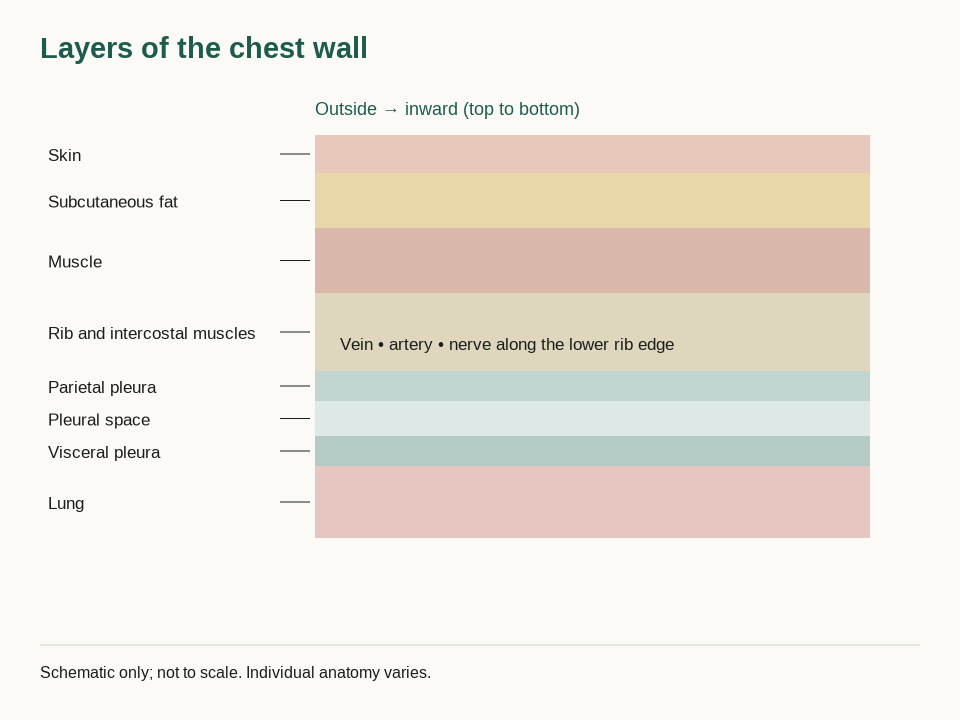
Changing a contour and understanding what lies beneath it are different matters. Recognising and managing a complication when it occurs is a separate capability.
Rib remodeling can cause complications involving chest-wall structures. Some are listed below; symptoms, timing and management are described on a separate page.
- Pneumothorax Pleural injury may allow air into the pleural space, causing partial lung collapse.
- Intercostal nerve injury Irritation or injury to nerves along the lower rib edge can cause persistent pain.
- Unintended rib fracture The applied force and bone quality may produce an unintended fracture, distinct from the incomplete fracture deliberately created during the operation.
Other possible complications include hemothorax, costochondritis, subcutaneous emphysema, infection and asymmetry.
Follow-up
Care does not end with surgery.
Chest-wall shape is not final immediately after surgery. Tissue adaptation and resolution of swelling take weeks to months, and care during this period influences the final result.
- Binder A binder helps the bone unite at the changed angle. Wearing periods vary between reports and are advised individually after assessment.
- How bone heals An incomplete fracture is intentionally created, so the bone must unite again. Less pain does not mean this process has finished.
- Follow-up Progress is assessed on a planned schedule with repeat measurements and imaging. Adherence to the compression protocol and activity restrictions is also reviewed.
- Postoperative CT Not taken on a fixed schedule. CT is obtained when indicated, such as for persistent pain or suspected nonunion.
The technique, extent of surgery and recovery depend on individual circumstances. If scheduled follow-up is difficult to attend, it is better to postpone surgery.
We document the clinical course systematically
Evidence for cosmetic rib remodeling is still developing. Long-term follow-up is limited and standardised outcome reporting is not yet established.
Preoperative measurements and imaging, scheduled follow-up and academic reporting are therefore part of our care process. Only data processed to prevent identification of individual patients are used.
Symptoms during recovery and how they are managed →
Bone healing and CT after surgery →
Dr. Dongju Seo, board-certified cardiothoracic surgeon
- Director, da Re-Fit Clinic
- Formerly at the Department of Cardiothoracic and Vascular Surgery, Asan Medical Center
- Training at Massachusetts General Hospital (MGH)
- Member, Korean Society for Thoracic and Cardiovascular Surgery
Chest-tube insertion, pleural procedures, intercostal nerve blocks, assessment of rib fractures and fixation are included in specialist training, rather than being unrelated skills learned separately.
We assess suitability first.
Contact us by telephone for an individual assessment and guidance. A consultation may not lead to surgery; that decision is also a valid outcome.
In depth
For readers who want to explore further.
How is the rib cage structured?
The 12 pairs of ribs, cartilage flexibility, age-related changes and the structures immediately beneath them.
Articles — A Surgeon Who Knows the Ribs
A thoracic surgeon’s articles on chest-wall anatomy, techniques and misconceptions.
Where did this operation come from?
A century of surgery on the chest wall, from the first attempt in 1911 to today.
Information
Applications for rib-remodeling models.
Model applications are separate from the clinical consultation above. Applying and making a clinical decision are distinct processes.
We seek people willing to document their clinical course and cooperate with the use of those records. The information page covers eligibility, exclusions, photography and data use, and possible complications.
Submitting an application does not confirm surgery. A decision follows assessment of suitability through specialist consultation and examination.
Questions about RIBXCAR.
What is RIBXCAR?
RIBXCAR (also written RibXcar) is a method of rib remodeling that changes the angle of the lower ribs without removing any rib, to change the skeletal contour of the upper waist. Instead of a skin incision, a fine instrument is passed through the skin and only the outer cortex of the rib is divided under ultrasound. It is not a fat-removal operation.
How does RIBXCAR work?
At the back of the lower rib only the outer cortex is divided, and the rib is bent inward with the inner cortex left connected. This is an incomplete (greenstick) fracture in which the rib is not split in two. A binder is worn so the bone heals at the new angle.
How is RIBXCAR different from rib removal?
Rib resection cuts part of a rib away. RIBXCAR keeps the rib and changes its angle. Resected tissue does not return. Risk exists in surgery that does not remove ribs as well, and safety cannot be judged from removal alone.
Is RIBXCAR the same as rib remodeling?
Rib remodeling is the name for surgery that changes the angle of the ribs while keeping them. RIBXCAR is the name of one method of rib remodeling, done without an incision and checked on ultrasound. da Re-Fit Clinic offers both RIBOSS with titanium plate fixation and RIBXCAR, selecting the approach according to the individual patient.
Does RIBXCAR affect breathing?
In a study of 294 women aged 18–38 tested before surgery and at 6 months and 1 year, spirometry values did not differ significantly from baseline. The study was done at a single center by the group that developed the technique, had no control group, and included only young women without lung disease followed for 1 year. Soon after surgery, chest wall complications such as pneumothorax can occur.
What are the risks of RIBXCAR?
Pneumothorax, hemothorax, pain from intercostal nerve injury, an unplanned rib fracture, a bicortical fracture in which the inner cortex also breaks, nonunion, infection and asymmetry can occur. In a cohort of 3,805 patients from 8 countries followed for 1 year, 4 pneumothoraces and 1 hemothorax were reported.
How do the ribs heal after RIBXCAR?
Because an incomplete fracture is made on purpose, the bone has to heal. The fracture passes through hematoma, soft callus and hard callus, and remodels over several months. Less pain does not mean this process is finished.
Can anyone have RIBXCAR?
No. With bone metabolic disease such as osteoporosis, a history of rib fracture, respiratory disease such as asthma or COPD, or connective tissue disease, the procedure is not recommended or further tests are needed first. With a chest wall deformity such as pectus excavatum or pectus carinatum, assessment as a chest wall deformity comes first, and suitability is then judged separately. If consultation and tests show it is not suitable, surgery is not performed.
Why is a binder worn after RIBXCAR?
Until it heals, the bent rib is pulled by the muscles attached to it. The binder helps the bone heal at the new angle. Reported periods differ (at least 2 months, at least 3 months), and the period is set according to the extent of surgery and recovery.
Can I have a RIBXCAR consultation in Korea?
da Re-Fit Clinic (162 Apgujeong-ro, Gangnam-gu, Seoul) offers consultation and surgery for RIBXCAR rib remodeling by a board-certified cardiothoracic surgeon. Consultations in English are held through One-Talkie, the clinic's live interpretation chat. A consultation does not always lead to surgery.
What should I check about a surgeon's expertise before RIBXCAR?
Check whether the surgeon knows the pleura, the lungs and the intercostal nerves and vessels beneath the ribs, and can recognise and manage a complication such as pneumothorax. It is also worth asking whether rib anatomy is checked on 3D CT before surgery, how the fracture and bone healing are confirmed during and after surgery, and what is done if a bicortical fracture or nonunion occurs.
Are there published studies on RIBXCAR?
Yes. After the first report of 30 patients in 2023, a multicenter cohort of 3,805 patients, a spirometry study of 294 patients and a meta-analysis of 4 studies with 318 patients have been published. Most have no control group, follow-up is 1 year or less, and many involve the group that developed the technique.
Clarify costs and follow-up together
What should I prepare if I am on hormone therapy or have had other body-contouring surgery?
List the names, doses and routes of your medicines, the duration of hormone therapy, the areas and dates of previous operations, and any further surgery you are planning. Bring existing CT images or operation records, but do not arrange new tests before receiving guidance. Do not stop or change medicines on your own; obtain individual advice from the prescribing and surgical teams. Suitability depends on your goals, health, rib anatomy and ability to attend follow-up.
Which items should I check when discussing the cost of RIBXCAR?
Check consultation and tests, surgery, anaesthesia and recovery observation, the binder, and planned follow-up separately. Distinguish included items from possible charges for additional tests or visits, and ask for an updated estimate if the surgical plan changes. A total price alone does not tell you whether examination and follow-up cover the same things. Ask for an explanation based on your proposed plan.
How should I plan surgery and return travel when visiting from another city or country?
Tell us your available dates, possible length of stay, return transport and companion arrangements. Plan consultation and tests, preparation and recovery observation if surgery is chosen, and checks before departure and afterwards as separate stages. A consultation booking does not confirm surgery, and flying or returning to work cannot be scheduled from the operation date alone. Before leaving, confirm binder instructions, the next visit, relevant treatment records and contact arrangements.
Plan your stay and follow-up before travelling.
Prepare existing records and discuss assessment, a companion, transport, binder use and checks after returning home.
Consulting in English.
Consultations in English are held through One-Talkie, the clinic's live interpretation chat. Please tell us your country, preferred dates, height and weight, medical history and the change you are hoping for.
- Address4F, 162 Apgujeong-ro, Gangnam-gu, Seoul, Republic of Korea
- Telephone+82-2-545-5101 (Korean)
- Manzaneda Cipriani RM, Duran H, Adrianzen GA, et al. A Multicenter Cohort Study of 3805 RibXcar Cases: Safety and Efficacy in Incisionless Rib Remodeling. Plast Reconstr Surg Glob Open. 2026;14(7):e7929. doi:10.1097/GOX.0000000000007929
- Manzaneda Cipriani RM, Duran Vega H, Cala Uribe L, et al. Waist Remodeling without Incision, with Ultrasound-guided Monocortical Fracture. Plast Reconstr Surg Glob Open. 2023;11(12):e5499. doi:10.1097/GOX.0000000000005499
- Milani-Reis A, Roca Mora MM, Bicudo Bregion P, et al. Rib Remodeling Without Rib Resection: A Systematic Review and Meta-analysis. Aesthetic Plast Surg. 2026;50(2):667-674. doi:10.1007/s00266-025-05240-w
- Danilla S, González-Arestizábal T. Costal Surgery for Waist Improvement Safety and Efficacy: A Systematic Review of the Literature. Aesthetic Plast Surg. 2025;49(12):3433-3442. doi:10.1007/s00266-025-04815-x
- Kudzaev KU, Kraiushkin IA. Waist Narrowing without Removal of Ribs. Plast Reconstr Surg Glob Open. 2021;9(7):e3680. doi:10.1097/GOX.0000000000003680
- Manzaneda Cipriani RM, Adrianzen GA. Respiratory Function Assessment After Waist Reduction Through Scarless Ultrasound-Guided Monocortical Fracture (RibXcar) Surgery for Body Contouring. Aesthet Surg J Open Forum. 2026;8:ojag007. doi:10.1093/asjof/ojag007
- Aburub A, Darabseh MZ, Badran R, et al. Ant-waist surgery adversely affects lung function: a cross-sectional study. Multidiscip Respir Med. 2024;19(1):984. doi:10.5826/mrm.2024.984
※ Rib remodeling is an elective cosmetic procedure. Complications such as pain, pneumothorax, asymmetry and problems with bone healing can occur. Suitability and results vary between individuals and should be decided with the medical team after examination and imaging.
Medical content: Dongju Seo, MD, board-certified cardiothoracic surgeon, da Re-Fit Clinic. Last reviewed .
Explore the detailed English articles: what RIBXCAR is · columns · complications · eligibility.