 da Re-Fit Clinic
RIBXCAR changes rib angles while keeping the ribs, rather than cutting them away. However, preservation does not mean preoperative structure and function remain unchanged. Incomplete fractures still need to heal, binder care is required, and complications must be considered.
Rib removal and angle-changing methods treat tissues differently. Their recovery processes and risks must be considered alongside the desired changes.
Removing tissue versus changing direction
Rib operations to change the upper-waist contour broadly fall into two groups: removing part of a rib, or keeping it and changing its angle.
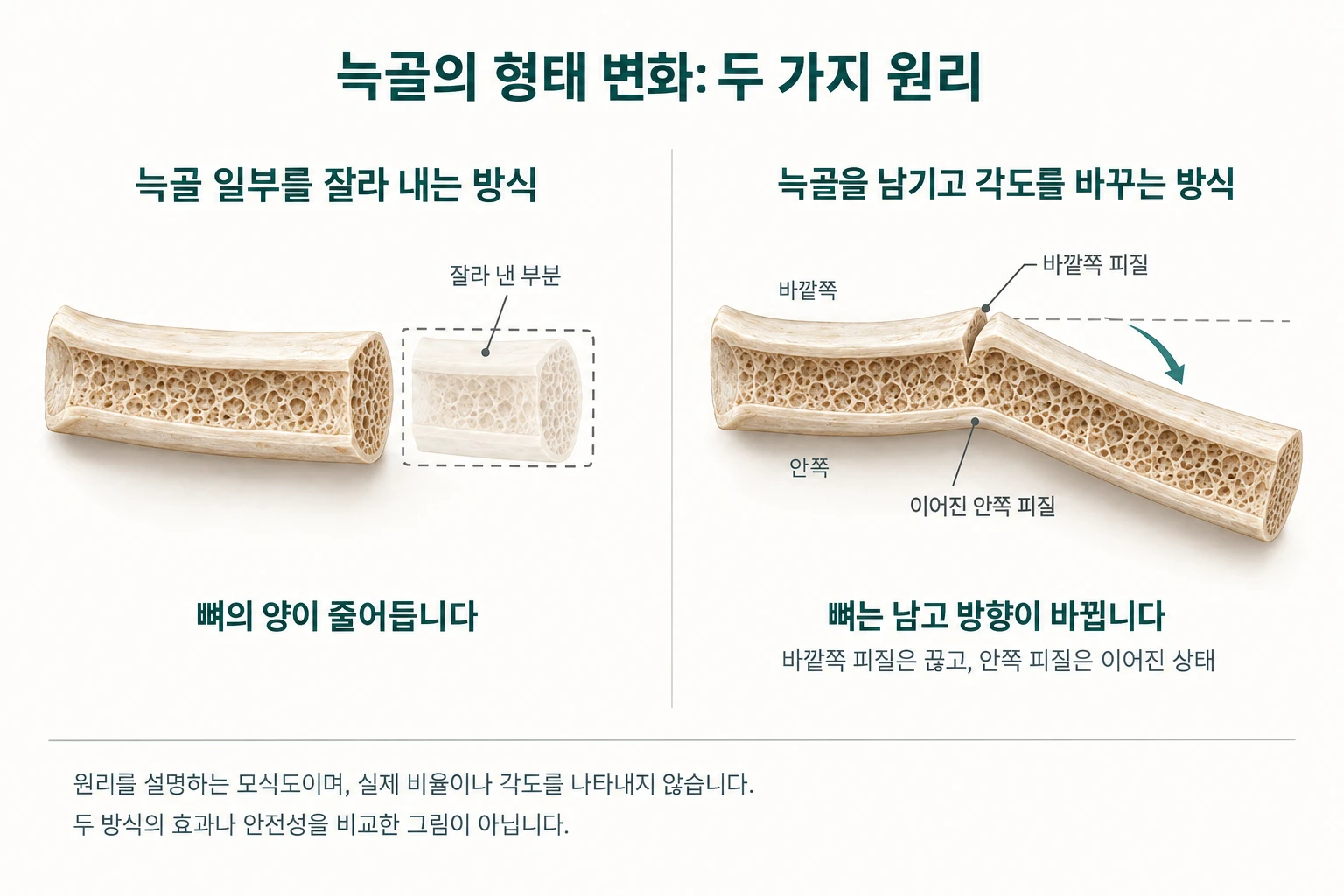
Removing tissue can change the contour, but the resected tissue does not return. This is a clear limitation when the aim is to preserve normal bone. Dissection and resection also require consideration of bleeding, pleural injury, nerve injury and pain.
A 2025 systematic review by Brazilian researchers examined 12 studies of cosmetic rib resection and rib remodeling. Risks such as pneumothorax and chronic pain were reported with rib resection, while fewer complications were reported with newer remodeling methods such as greenstick fracture. However, without long-term or randomised comparative studies, the authors could not draw definitive conclusions about effectiveness and safety.1
Operations that do not remove ribs also carry risks. Safety cannot be judged from removal alone.
How does RIBXCAR change the angle?
RIBXCAR makes an osteotomy only in the outer cortex at the back of the lower rib, then bends the rib inward while leaving the inner cortex connected. A fine instrument is inserted through the skin instead of an incision, with ultrasound used to check the rib and surrounding structures.2 Rather than taking bone out, the direction is adjusted while the bone remains.
- In the first study of 30 patients, the change in rib angle measured by ultrasound was maintained at 3 months.2
- In a study of 3,805 patients from 8 countries followed for one year, the angles of ribs 10–12 decreased by an average of 10 degrees.3
→ Article 05 explains the principle of greenstick fracture
The most direct advantage
The ribs are not cut away. If the upper waist looks wide because of the ribs’ position and angle rather than their bulk, changing direction without removing normal tissue is a meaningful approach.
A 2025 meta-analysis of 4 studies involving 318 patients undergoing rib remodeling without rib removal found an average waist reduction of 8.6 cm at 3 months, with no reported pneumothorax or hemothorax.4 However, none of the four studies had a control group, most patients also underwent procedures such as liposuction, and one co-author developed RIBXCAR. The 3,805-patient study reported 4 pneumothoraces and 1 hemothorax.3
Use the word preservation precisely
It means that the ribs remain, not that their preoperative structure and function remain entirely unchanged.
- An incomplete fracture is created intentionally, so the bone must unite again.
- A binder must be worn during recovery and scheduled follow-up attended.
- If the inner cortex breaks or the bone fails to unite, chronic pain may persist.3
Not removing bone does not justify promising less pain, faster recovery or freedom from complications.
If the ribs look prominent—where is the prominence?
A preservation-based approach raises questions not just about waist circumference but also about how to address the shape of prominent ribs.
Outward flaring of the lower costal margin toward the front or sides is often called rib flare. The location of the prominence matters.
- The direction of the lower rib shafts may be the issue—in which case it overlaps with the area targeted by RIBXCAR for waist contouring.
- The anterior costal cartilage and costal margin may be prominent—this is a different area and requires a different approach.
Even if the external appearances are similar, the same operation cannot address every case. Examination and CT identify which structures are involved.
A clinical report described correcting anterior rib prominence by passing a fine instrument through the skin to the cartilage junction, without removing costal cartilage. In 32 women operated on under general anesthesia and followed for 6 months, anterior chest length decreased by an average of 9.66 cm, lung-function tests showed no significant change at 6 months, and no complications were reported.5
This suggests a possible approach to prominence while preserving ribs and cartilage. However, it is a different technique from RIBXCAR, reported by its developers without a control group and with only 6 months of follow-up. It is not evidence that the method applies to all rib flare.
Chest-wall deformities are a separate field
For some localised rib prominences or shape abnormalities, rib-preserving remodeling may be considered after precise anatomical assessment. This must not be broadened into a claim that RIBXCAR treats chest-wall deformities.
Pectus excavatum and pectus carinatum, where the sternum and costal cartilage are deformed together, require separate assessment. Treatment may involve bracing or chest-wall correction depending on the type and severity. RIBXCAR has not been shown to replace these treatments. The deformity and cardiopulmonary condition should be assessed first, followed by any remaining localised contour concerns. → Chest-wall deformities and when the procedure is not recommended
Questions for consultation
- Whether my contour is mainly shaped by fat, lower-rib angles or anterior costal cartilage
- Rib number, length and cartilage connections on CT
- Which areas can be changed and which should be left as they are
- Whether I can adhere to binder use and follow-up appointments
The advantage of RIBXCAR is that it can adjust shape without removing the ribs. To use that advantage appropriately, what can be changed and what should be preserved must be considered together.
References
- Ferreira LM, Bonin GS, Bernardes ABS, et al. Is There Scientific Evidence on the Practice of Rib Resection or Remodeling for Body Contouring Purposes?—A Systematic Review. Aesthetic Plast Surg. 2025;49(7):2007-2014. doi:10.1007/s00266-025-04685-3
- Manzaneda Cipriani RM, Duran Vega H, Cala Uribe L, et al. Waist Remodeling without Incision, with Ultrasound-guided Monocortical Fracture. Plast Reconstr Surg Glob Open. 2023;11(12):e5499. doi:10.1097/GOX.0000000000005499
- Manzaneda Cipriani RM, Duran H, Adrianzen GA, et al. A Multicenter Cohort Study of 3805 RibXcar Cases: Safety and Efficacy in Incisionless Rib Remodeling. Plast Reconstr Surg Glob Open. 2026;14(7):e7929. doi:10.1097/GOX.0000000000007929
- Milani-Reis A, Roca Mora MM, Bicudo Bregion P, et al. Rib Remodeling Without Rib Resection: A Systematic Review and Meta-analysis. Aesthetic Plast Surg. 2026;50(2):667-674. doi:10.1007/s00266-025-05240-w
- Manzaneda Cipriani RM, Adrianzen GA. Ribs with Anterior Protrusion (Winged Ribs) Treated Using Percutaneous Chondroplasty. Plast Reconstr Surg Glob Open. 2024;12(9):e6178. doi:10.1097/GOX.0000000000006178
Rib remodeling is an elective cosmetic operation. Suitability and outcomes vary with individual anatomy and health. A decision should follow examination, testing and a thorough discussion with the medical team.
→ What is RIBXCAR?
→ More on rib-cage anatomy
→ Possible complications
→ When the procedure is not recommended