 da Re-Fit Clinic
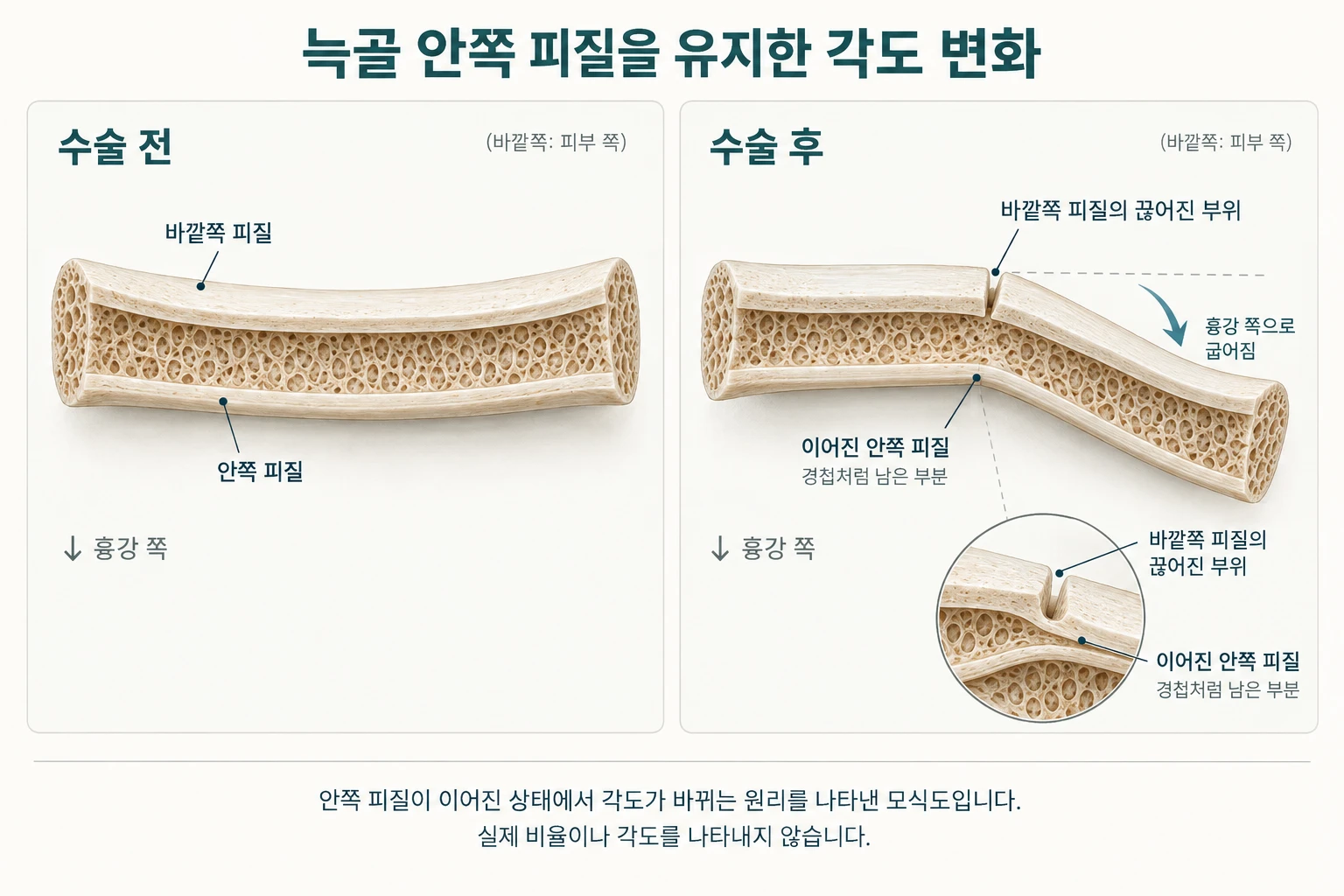
A greenstick fracture is an incomplete fracture: one side of a bone breaks while the other stays connected. RIBXCAR changes rib angles by dividing the outer cortex while retaining the inner connection. Even without removing bone, fracture healing is still required.
The first published study called this a monocortical fracture.1 Here is what the term greenstick fracture means in this operation.
The term greenstick fracture
A dry branch snaps in two when bent. A fresh, moist branch can split on one side while remaining connected on the other. This appearance gives the greenstick fracture its name.
The term originally comes from fractures in children. Children’s bones bend more readily than adult bones, so these fractures commonly occur in places such as the forearm.3 Adult ribs do not bend as readily as children’s bones. To bend them at a selected location and in a selected direction, one cortex is divided first.
How it is created in an adult rib
The hard outer layer of a rib is cortical bone. A rib has a cortex facing outward and another facing toward the lung.
- An osteotomy is made only in the outer cortex at the back of the lower rib.
- Gradual force is applied to the rib end, bending it inward. The osteotomy opens and creates an angle.
- The inner cortex is left intact, connecting the two parts.
A method reported in 2021 reached the rib through an approximately 2 cm incision, divided the outer cortex with a saw or piezoelectric device, and created a greenstick fracture using finger pressure.2 RIBXCAR performs the same osteotomy under ultrasound guidance by inserting a fine instrument through the skin instead of making an incision.15 The authors of the 3,805-patient study described the retained inner cortex as a “fixed hinge.”5
A hinge is an analogy for the principle. It does not mean the bone moves like a mechanical component or bends into the same shape in every person.
Excessive force can break the inner cortex too. In an experiment on 50 pig ribs, perpendicular point osteotomies produced monocortical fractures at an average of 6.67 newtons and bicortical fractures at 10.0 newtons.4 These are animal bones tested outside the body, so the values cannot be applied directly to human surgery. The authors stated that avoiding bicortical fractures is essential to reducing complications.
An incomplete fracture is still a fracture
“The bone is not completely separated” does not mean its position or shape is unchanged. Changing the angle of the lower ribs is the purpose of the operation.
- The first study of 30 patients measured rib angles by ultrasound before surgery, immediately afterwards, and at 1 and 3 months to assess whether the change was maintained.1
- In a study of 3,805 patients from 8 countries followed for one year, the angles of ribs 10–12 decreased by an average of 10 degrees.5
How this change appears on later CT is discussed in Article 04.
How is it checked during surgery?
A cracking sound may occur when the rib is bent. Sound alone cannot identify the fracture shape or angle. In a study of 100 patients, a sound was heard in only 90, but immediate postoperative ultrasound confirmed a monocortical fracture in all 100. The author proposed using ultrasound to confirm the angle change and bone continuity rather than using sound as the endpoint.6
Ultrasound does not eliminate the possibility of injury. The complications described below were reported in ultrasound-guided operations.
How bone heals
Fractures heal in stages. The American College of Surgeons’ chest-wall injury guidelines describe the process as follows:7
- A hematoma forms at the fracture and an inflammatory response begins.
- A soft callus containing cartilage bridges the gap.
- Within weeks, it changes into hard, bony callus.
- Over several months, remodeling restores the structure of cortical and cancellous bone.
A CT follow-up study of 100 patients with traumatic rib fractures found bony callus after an average of 18 days in younger adults, 24 days in middle-aged adults and 28 days in older adults.8
Union, which reconnects the bone, and remodeling, which reorganises its structure, are linked but distinct stages. Less pain does not mean this process is finished.
Why a binder is worn
Until it heals, the bent rib remains subject to the pull of attached muscles.5 A binder helps the bone unite at the changed angle. Reported wearing periods vary.
- The 2021 study required at least 2 months of use, stopping after CT confirmed union.2
- The 3,805-patient study recommended at least 3 months.5
- A 2026 case report used 6 weeks.11
Loss of correction has also been reported. In the 2021 study, 3 patients who did not adhere to corset use had no waist reduction and underwent repeat surgery within 5 months.2 A study comparing 240 patients defined recurrence as an increase in waist circumference during follow-up and reported different rates depending on osteotomy direction.9
Duration and method must be decided according to the extent of surgery and recovery. There is no single fixed standard.
When things do not go as planned
An incomplete fracture does not guarantee quick recovery or an uncomplicated course.
- The 3,805-patient study reported 4 pneumothoraces and 1 hemothorax, as well as chronic pain associated with bicortical fractures and pseudarthrosis from failure of union.5
- An international survey covering 2,351 patients treated by various rib-remodeling methods reported complications in 86 patients (3.7%); 15.1% of these complications involved failure of bone union.10
- An incomplete fracture is not necessarily a milder fracture than a complete one. In a study of 420 children with forearm greenstick fractures, fractures treated while remaining incomplete had a higher refracture rate than those completed before treatment (15.2% versus 3%).3 This is indirect evidence from children’s forearm bones.
Questions for consultation
- How much correction is possible with my rib anatomy?
- How will fracture shape and union be assessed during and after surgery?
- How long and how should I wear the binder, and when can I resume activities?
- How would a bicortical fracture or nonunion be managed?
Greenstick fracture describes the principle of the operation. The actual outcome depends on both correction and the healing that follows.
References
- Manzaneda Cipriani RM, Duran Vega H, Cala Uribe L, et al. Waist Remodeling without Incision, with Ultrasound-guided Monocortical Fracture. Plast Reconstr Surg Glob Open. 2023;11(12):e5499. doi:10.1097/GOX.0000000000005499
- Kudzaev KU, Kraiushkin IA. Waist Narrowing without Removal of Ribs. Plast Reconstr Surg Glob Open. 2021;9(7):e3680. doi:10.1097/GOX.0000000000003680
- Petnehazy T, Münnich M, Füsi F, et al. Greenstick fractures of the forearm shaft — Is it obligatory or facultative to break the cortex? (Article in German). Unfallchirurgie (Heidelb). 2024;127(10):713-721. doi:10.1007/s00113-024-01477-3
- Manzaneda Cipriani RM, Duran H, Adrianzen GA, et al. RibXcar with Dots Point Technique: The Science of Fracture as a Safety Principle. Plast Reconstr Surg Glob Open. 2026;14(6):e7816. doi:10.1097/GOX.0000000000007816
- Manzaneda Cipriani RM, Duran H, Adrianzen GA, et al. A Multicenter Cohort Study of 3805 RibXcar Cases: Safety and Efficacy in Incisionless Rib Remodeling. Plast Reconstr Surg Glob Open. 2026;14(7):e7929. doi:10.1097/GOX.0000000000007929
- Manzaneda Cipriani RM. Is “Clack” Enough? Rib Remodeling Guided by Ultrasound. Plast Reconstr Surg Glob Open. 2024;12(5):e5843. doi:10.1097/GOX.0000000000005843
- American College of Surgeons Committee on Trauma. Best Practices Guidelines: Management of Chest Wall Injuries. November 2025. Principles of Plate Fixation and Bone Healing, p. 39. facs.org (PDF)
- Hu J, Zheng ZF, Wang SH, et al. Missed rib fractures on initial chest CT in trauma patients: time patterns, clinical and forensic significance. Eur Radiol. 2021;31(4):2332-2339. doi:10.1007/s00330-020-07310-w
- Manzaneda Cipriani R, Vega HD, Flores E, et al. Scarless Rib Reshaping: Comparison of Straight and Oblique Approaches in Terms of Efficacy and Recurrence. Plast Reconstr Surg Glob Open. 2026;14(5):e7697. doi:10.1097/GOX.0000000000007697
- Aguilar HA, Hoyos AE, Ramirez B, et al. Global Survey on Rib Remodeling Techniques: Assessing Complications and Safety in Waistline Contouring. Plast Reconstr Surg Glob Open. 2026;14(4):e7609. doi:10.1097/GOX.0000000000007609
- González-Arestizábal T, Kohnenkampf R, Domínguez C. Rib remodeling as a thoracic feminization strategy in transfeminine patients: Case report. JPRAS Open. 2026;49:349-354. doi:10.1016/j.jpra.2026.02.018
Rib remodeling is an elective cosmetic operation. Suitability and outcomes vary with individual anatomy and health. A decision should follow examination, testing and a thorough discussion with the medical team.
→ What is RIBXCAR?
→ More on rib-cage anatomy
→ Possible complications
→ When the procedure is not recommended