 da Re-Fit Clinic
Preoperative 3D CT assesses rib number, length, side-to-side differences and cartilage connections. While ultrasound checks instruments and ribs during surgery, CT helps plan which structures to address and how. CT alone cannot predict the result.
Your ribs may differ from a textbook
Textbooks describe 12 pairs of ribs: true ribs 1–7, false ribs 8–10 and floating ribs 11–12. Actual anatomy frequently departs from this classification.
- A study of chest CT in 1,120 adults found congenital rib variations in 18.57%. Underdeveloped ribs (hypoplasia) were most common, followed by absent ribs.1
- Among 234 people undergoing CT for vertebral fractures, 8 (3.4%) had 11 rather than 12 pairs of ribs.2
- A meta-analysis of 9 studies estimated the prevalence of a 13th rib attached to a lumbar vertebra (lumbar rib) at 2.1%.3
- In CT measurements of 83 women aged 18–35, rib 12 ranged from 8 to 12 cm in length, and one woman (1.2%) had unequal lengths on the two sides.4
With 11 or 13 pairs, numbering from the outside can shift by one level, risking treatment of a different rib from the one intended. If rib 12 is short or absent on one side, the same operation should not be performed on both sides. Palpation or ultrasound alone may not reliably establish these features.
Is rib 10 a false rib or a floating rib?
This is a key question in planning surgery. Textbooks call rib 10 a false rib, connected by cartilage to the rib above. Direct examination, however, has often found otherwise.
A 2022 US study directly dissected ribs 9 and 10 on both sides of 40 cadavers, examining 80 sides.5
| Rib | Attached to the rib above | Floating |
|---|---|---|
| Rib 9 | 100% (cartilage connection to rib 8) | — |
| Rib 10 | 18% (connected to rib 9) | 59% (floating, like a floating rib) |
The authors concluded that rib 10 is usually floating. This small study used 40 cadavers with a mean age of 83, so its proportions cannot be directly applied to younger people. However, whether rib 10 is attached or floating can vary between people and between sides. This is why CT is checked for each individual.
If ribs 9 and 10 are included, check the cartilage connections first
RIBXCAR divides only the outer cortex and bends the rib inward. For floating ribs such as 11 and 12, which have no anterior attachment, bending at the back allows the whole rib to move inward.
A rib attached anteriorly to the cartilage above behaves differently. Even when bent posteriorly, its anterior fixation pulls it back toward the original position. The technique’s authors described this force as limiting correction and potentially increasing the risk of bicortical fracture or pseudarthrosis.6
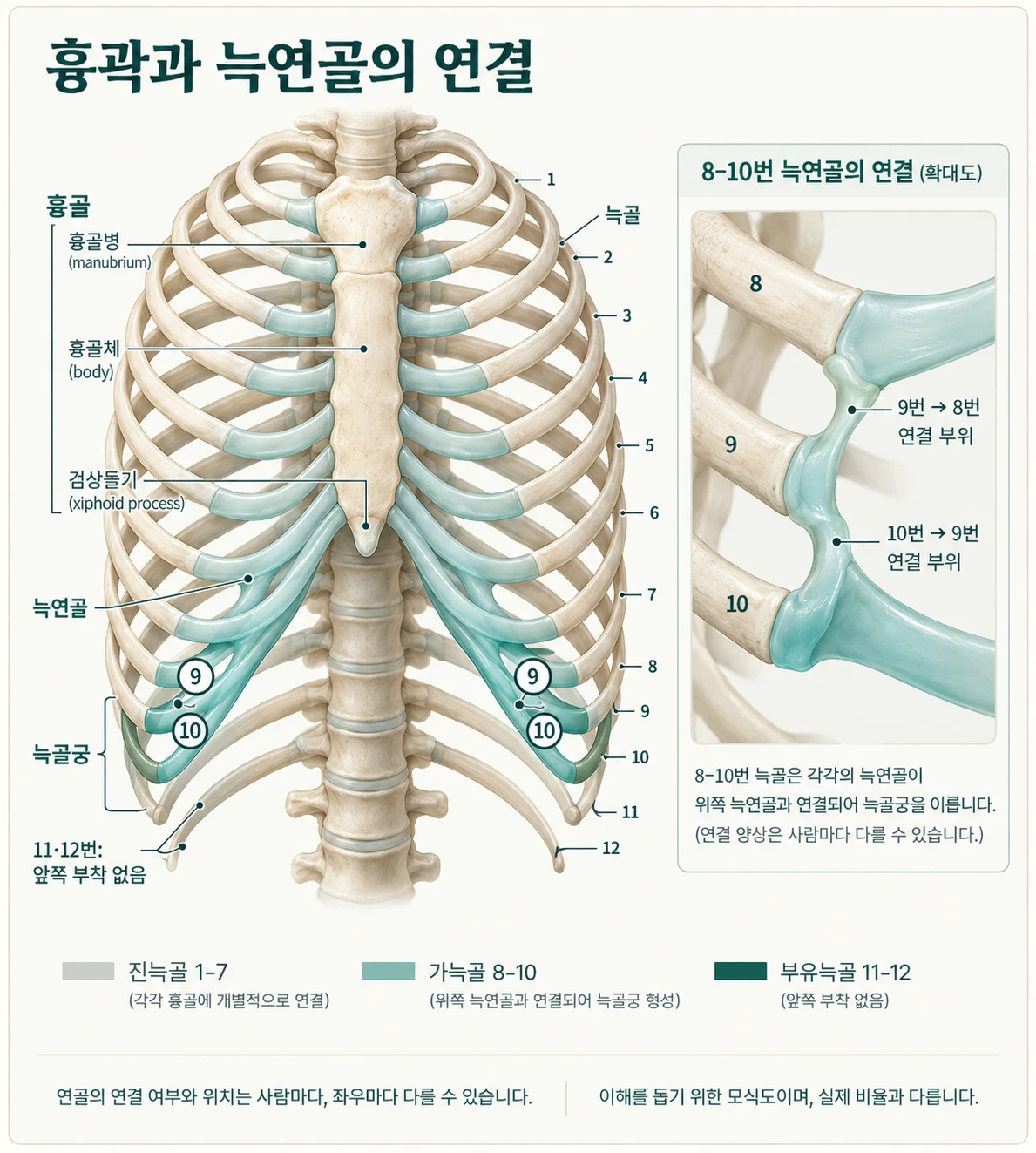
When RIBXCAR is planned for ribs 9 or 10 and CT shows a cartilage connection, the cartilage connection is separated first, making the rib function like a floating rib before its angle is changed. A fine instrument separates the junction under ultrasound guidance, without a skin incision.6
The 2024 study reporting this method used CT findings to determine treatment as follows:6
- Rib 9: add separation if CT shows a cartilage connection to rib 8.
- Rib 10: add separation if CT shows a cartilage connection to rib 9.
- Ribs 11 and 12: no separation is needed because they lack anterior attachments.
The same study compared 49 women in two groups at 6 months. The 26 patients who also underwent cartilage separation at ribs 9 and 10 had an average waist reduction of 17.0 cm, versus 8.7 cm in 23 patients receiving RIBXCAR alone. Immediate rib-9 angle change was also greater with separation (11.0 versus 5.1 degrees on average). There was no pneumothorax or hemothorax; 2 patients without separation experienced neuropathic pain.6
However, the study was performed by the technique’s developers, was not randomised and followed patients for only 6 months. Independent confirmation is not yet available. Adding cartilage separation also increases the extent of the procedure. Inclusion of ribs 9 and 10 must weigh CT findings, potential change and the additional burden.
Why 3D reconstruction and a cartilage window?
Having CT does not automatically show everything needed. Reconstruction settings matter.
- 3D reconstruction — Displays the ribs in three dimensions to count them and compare lengths and directions on both sides. It helps reveal asymmetry and variants that can be missed on sectional images.4
- Cartilage window — Costal cartilage is less dense than bone and may not be clearly visible on bone settings. The settings must display cartilage to assess the connections of ribs 9 and 10.6
The authors reporting cartilage separation of ribs 9 and 10 described requesting both 3D reconstruction and a cartilage window as ideal.6 The authors of the 3,805-patient study across 8 countries also recommended 3D CT for preoperative planning.7
What CT checks
| Feature assessed | Implication for surgical planning |
|---|---|
| Number of ribs | With 11 or 13 pairs, numbering changes. Identify the intended ribs accurately. |
| Length and symmetry of rib 12 | A short or absent rib changes whether rib 12 is treated, and whether treatment is unilateral. |
| Whether rib 10 is floating | If it is floating, it is treated in the same way as ribs 11 and 12. |
| Cartilage connections of ribs 9 and 10 | If a connection exists, treating that rib requires cartilage separation. |
| Rib length and angle, and distance to the iliac crest | Identify which ribs contribute to the waist contour. |
| Depth from skin to rib | Determine instrument length and approach. |
| Spinal curvature and chest-wall deformity | May require different plans on the two sides or support a recommendation against surgery. |
| Condition of the lungs and pleura | Document the preoperative state and identify abnormalities that need attention. |
One study also used CT measurements to define the extent of surgery. A 2025 report of 125 patients routinely treated ribs 10 and 11 bilaterally, adding rib 12 when it was 7 cm or shorter or the torso was short. It also recommended first checking that both 12th ribs were present and symmetrical.8 Techniques and criteria differ between studies, so these numbers are not universal rules. This is an example of how CT informs the extent of surgery.
What CT cannot tell us
- CT shows anatomy, but cannot predict how much waist circumference will change after surgery.
- CT cannot replace checks during surgery. Ultrasound is used to assess the bent angle and bone continuity.
- CT uses radiation. It is therefore required for preoperative planning here, but obtained after surgery only for a specific reason. → Article 04
Questions for consultation
- How many pairs of ribs do I have, and are both 12th ribs present?
- Is my 10th rib floating or attached to rib 9?
- If ribs 9 and 10 are treated, will cartilage separation be needed?
- Will CT be reviewed with 3D reconstruction and a cartilage window?
Even under the same procedure name, the extent and method differ between people. Preoperative 3D CT helps determine those differences.
References
- Oner Z, Oner S, Sahin NE, Cay M. Evaluation of congenital rib anomalies with multi-detector computed tomography in the Turkish population. Folia Morphol (Warsz). 2024;83(1):182-191. doi:10.5603/FM.a2023.0006
- Gonzales-Portillo GS, Rizvi O, Avila MJ, Dumont TM. The prevalence of 11 ribs and its potential implications in spine surgery. Clin Neurol Neurosurg. 2021;203:106544. doi:10.1016/j.clineuro.2021.106544
- Osiowski M, Osiowski A, Preinl M, et al. Prevalence and characteristics of lumbar ribs: a meta-analysis with anatomical and clinical considerations. Surg Radiol Anat. 2024;46(12):2057-2066. doi:10.1007/s00276-024-03504-9
- Manzaneda RM, Verdugo JP, Vega HD, et al. Anatomical Bases for Aesthetic Costal Surgery: Assessing the Thoracoabdominal Limits. Plast Reconstr Surg Glob Open. 2023;11(11):e5376. doi:10.1097/GOX.0000000000005376
- Laswi M, Lesperance R, Kaye A, et al. Redefining the costal margin: A pilot study. J Trauma Acute Care Surg. 2022;93(6):762-766. doi:10.1097/TA.0000000000003792
- Manzaneda RM, Adrianzen GA. Waist Reduction through Conversion from False to Floating Ribs. Plast Reconstr Surg Glob Open. 2024;12(6):e5900. doi:10.1097/GOX.0000000000005900
- Manzaneda Cipriani RM, Duran H, Adrianzen GA, et al. A Multicenter Cohort Study of 3805 RibXcar Cases: Safety and Efficacy in Incisionless Rib Remodeling. Plast Reconstr Surg Glob Open. 2026;14(7):e7929. doi:10.1097/GOX.0000000000007929
- Hoyos AE, Perez Pachon ME, Duarte P, et al. Waistline Aesthetic Slimming by Puncture and Parallel Approach for Rib Remodeling Procedures. Aesthet Surg J Open Forum. 2025;7:ojaf044. doi:10.1093/asjof/ojaf044
Rib remodeling is an elective cosmetic operation. Suitability and outcomes vary with individual anatomy and health. A decision should follow examination, testing and a thorough discussion with the medical team.
→ More on rib-cage anatomy
→ Possible complications
→ When the procedure is not recommended