 da Re-Fit Clinic
The Korean terms neukgol and galbippyeo both mean ribs; they do not refer to different bones. There are usually 12 on each side, 24 in total, connecting to the thoracic spine behind and surrounding the chest. They are classified as true, false or floating according to their anterior attachments, with shape and movement differing by location.
“I heard floating ribs are ribs we do not need.” I hear this in consultations. It is not true. Understanding the rib types helps explain why—and why surgical plans differ between people.
Ribs are divided into three types
Anatomy divides the ribs into three groups according to where they attach at the front.
| Type | Number | Anterior connection |
|---|---|---|
| True ribs (true ribs) | 1–7 | Each connects directly to the sternum through its own costal cartilage. |
| False ribs (false ribs) | 8–10 | They connect indirectly through the cartilage of the rib above. |
| Floating ribs (floating ribs) | 11–12 | They have no anterior connection and end within the abdominal wall muscles. |
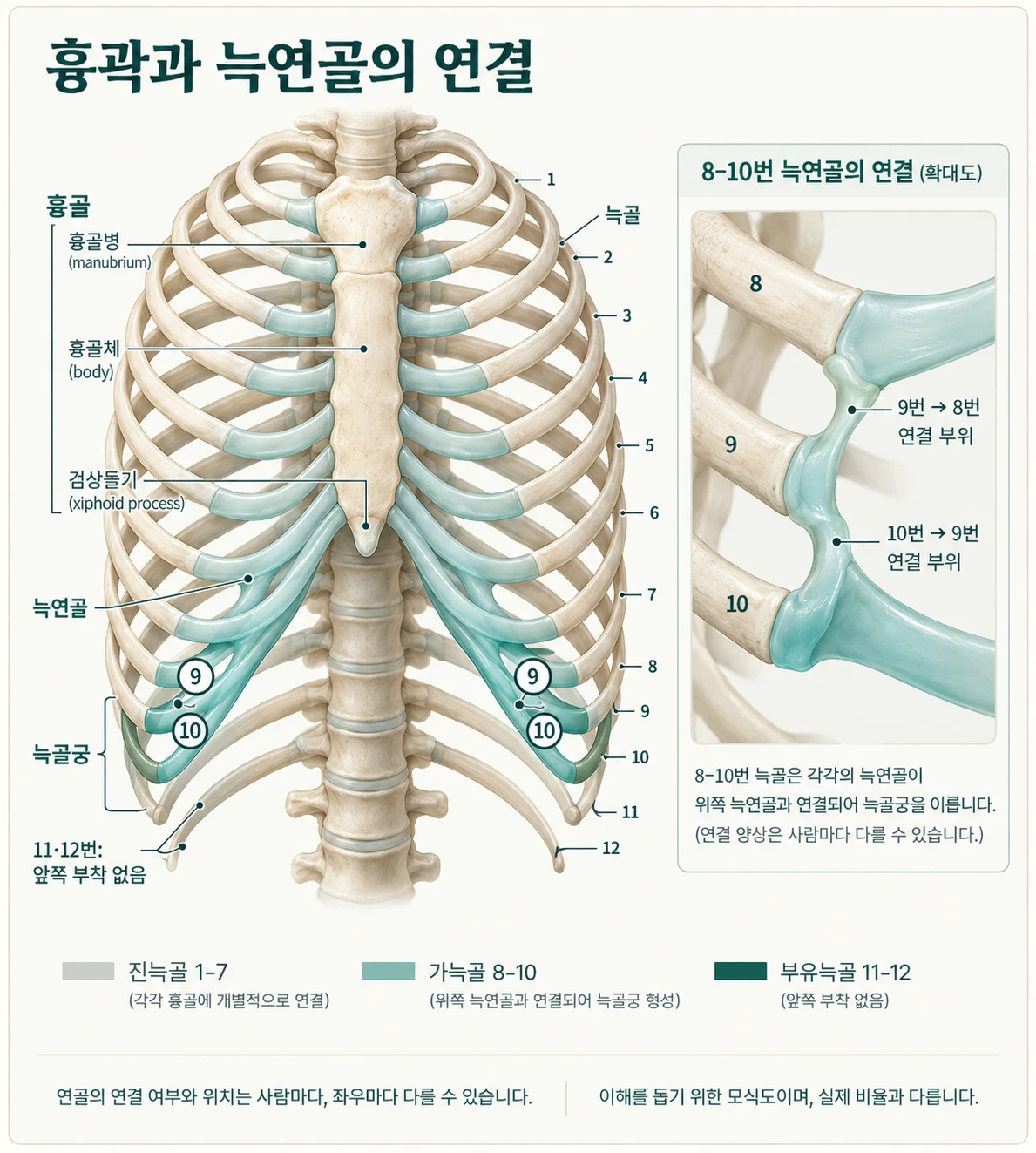
Ribs 1–7: true ribs
Ribs 1–7 connect directly to the sternum through costal cartilage, forming rings fixed at both ends. They shape the upper chest and protect the heart and lungs.
During inhalation, these ribs rise upward and forward, lifting the sternum and increasing the chest’s front-to-back diameter: pump-handle motion. A CT study found that full inhalation rotated rib 3 by 11 degrees and rib 7 by 7 degrees in this direction. This movement decreases further down.1
Their firm connection to the sternum, with clavicles and shoulder blades above, leaves the least room for shape alteration.
Ribs 8–10: false ribs
Ribs 8, 9 and 10 do not reach the sternum directly. They connect through the cartilage above, forming the lower border of the rib cage—the costal margin.
The middle and lower ribs move outward during inhalation, widening the chest through bucket-handle motion.1
This region also matters for body contour. A wide lower chest and more horizontal ribs can make the line toward the waist look broad. However, waist shape also depends on fat and muscle thickness, pelvic width, spinal alignment and posture. → Article 03
Ribs 11–12: floating ribs
Ribs 11 and 12 articulate with the spine at the back, but their front ends have no attachment and end in abdominal-wall muscle. They are called floating because their anterior ends appear free.
Floating does not mean unnecessary.
- Abdominal muscles—the external and internal obliques and transversus abdominis—attach to them and stabilise the chest and spine.2
- They shield organs in the upper posterior abdomen, including the kidneys, from behind.
- They also move during breathing.
A study comparing 11 women who had ribs 11 and 12 removed for cosmetic reasons with women who had not found lower FEV1 and expiratory muscle strength in the surgical group.2 The groups were small, with 11 participants each, and there were no preoperative data. Nevertheless, the findings caution against simply describing floating ribs as dispensable. → Article 09
This is also why rib remodeling changes the angles of these ribs rather than removing them.
Real anatomy often differs from textbook categories
That is the textbook account. Actual anatomy often departs from it.
- A floating rib 10 — In a dissection study of 40 cadavers, rib 10 attached to rib 9 in 18% of cases, while 59% were floating. Rib 9 was attached to rib 8 in all cases.3
- In a study of 294 surgical patients aged 18–38, rib 10 was not connected to rib 9 in 179 women (61%) and was connected in 115 (39%).4
- Different rib numbers — Among 234 people undergoing CT, 3.4% had 11 pairs of ribs;5 a meta-analysis estimated a 13th rib attached to a lumbar vertebra in 2.1%.6
- Different lengths and shapes — CT in 1,120 adults showed congenital rib variations in 18.57%.7 In CT scans of 83 women, rib 12 ranged from 8 to 12 cm in length.8
Most of these differences are normal variations rather than disease. They usually cause no discomfort and need not be known in daily life. But when changing rib shape, they alter the plan. A rib’s number alone does not establish its structure. → Why 3D CT is taken before surgery
Assess structure, not just numbers
When assessing the rib cage for body contour, I look beyond rib numbers to:
- The direction in which the ribs extend
- The width of the lower rib cage
- The space between the pelvis and rib cage
- Any side-to-side differences
- The distribution of muscle and fat over them
There are usually 12 pairs of ribs, but each rib cage differs. Rib remodeling is not the same operation on the same numbered ribs for everyone. It starts with understanding each person’s anatomy.
Questions for consultation
- How many pairs of ribs do I have, and are both sides the same?
- Is my rib 10 a false rib, or does it float?
- Which ribs contribute to my waistline?
- Which ribs will be left untreated, and why?
References
- Wilson TA, Rehder K, Krayer S, et al. Geometry and respiratory displacement of human ribs. J Appl Physiol (1985). 1987;62(5):1872-1877. doi:10.1152/jappl.1987.62.5.1872
- Aburub A, Darabseh MZ, Badran R, et al. Ant-waist surgery adversely affects lung function: a cross-sectional study. Multidiscip Respir Med. 2024;19(1):984. doi:10.5826/mrm.2024.984
- Laswi M, Lesperance R, Kaye A, et al. Redefining the costal margin: A pilot study. J Trauma Acute Care Surg. 2022;93(6):762-766. doi:10.1097/TA.0000000000003792
- Manzaneda Cipriani RM, Adrianzen GA. Respiratory Function Assessment After Waist Reduction Through Scarless Ultrasound-Guided Monocortical Fracture (RibXcar) Surgery for Body Contouring. Aesthet Surg J Open Forum. 2026;8:ojag007. doi:10.1093/asjof/ojag007
- Gonzales-Portillo GS, Rizvi O, Avila MJ, Dumont TM. The prevalence of 11 ribs and its potential implications in spine surgery. Clin Neurol Neurosurg. 2021;203:106544. doi:10.1016/j.clineuro.2021.106544
- Osiowski M, Osiowski A, Preinl M, et al. Prevalence and characteristics of lumbar ribs: a meta-analysis with anatomical and clinical considerations. Surg Radiol Anat. 2024;46(12):2057-2066. doi:10.1007/s00276-024-03504-9
- Oner Z, Oner S, Sahin NE, Cay M. Evaluation of congenital rib anomalies with multi-detector computed tomography in the Turkish population. Folia Morphol (Warsz). 2024;83(1):182-191. doi:10.5603/FM.a2023.0006
- Manzaneda RM, Verdugo JP, Vega HD, et al. Anatomical Bases for Aesthetic Costal Surgery: Assessing the Thoracoabdominal Limits. Plast Reconstr Surg Glob Open. 2023;11(11):e5376. doi:10.1097/GOX.0000000000005376
Rib remodeling is an elective cosmetic operation. Suitability and outcomes vary with individual anatomy and health. A decision should follow examination, testing and a thorough discussion with the medical team.
→ More on rib-cage anatomy
→ Possible complications
→ When the procedure is not recommended