 da Re-Fit Clinic
RIBXCAR inserts a fine instrument through the skin rather than making an incision. Under ultrasound guidance, only the outer cortex of the lower ribs is divided to change their angle. It differs in principle from rib resection, which removes bone.
It is not an operation to remove fat. Suitability and risk depend on rib anatomy and health. If consultation and examinations indicate that surgery is unsuitable, we do not proceed.
On this page
RIBXCAR: definition and background
Definition of the technique
The upper-waist contour depends not only on fat but also on the width and angles of the lower ribs. RIBXCAR changes their angles while keeping the ribs. In Korean it is written 립스카; publications use the spelling RibXcar.
Origins of the operation
A method of narrowing the waist without rib removal was first reported in 2021. An approximately 2 cm incision exposed the rib, the outer cortex was divided with a saw or piezoelectric device, and finger pressure created a greenstick fracture.2
In 2023, the same osteotomy performed without an incision under ultrasound guidance was reported with outcomes in 30 patients. The study called it a monocortical fracture.1 Multicenter cohort and lung-function studies followed, largely from the same research group.47
How it differs from earlier methods
- Unlike rib resection, it does not cut away ribs.
- Instead of reaching the rib through an incision, a fine instrument is inserted and osteotomy performed under ultrasound guidance.14
The wider history of surgery on the chest wall is described in History of Rib Surgery.
How RIBXCAR works
Lower-rib anatomy
The 12 pairs of ribs comprise true ribs (1–7), false ribs (8–10) and floating ribs (11–12), differing in anterior attachments and movement. The procedure mainly targets ribs 10–12, with rib 9 included when needed. Rib-10 connections vary between people.
→ True, false and floating ribs
How the angle is changed
The hard outer layer of a rib is cortical bone. A rib has a cortex facing outward and another facing toward the lung.
- An osteotomy is made only in the outer cortex at the back of the lower rib.
- Gradual force is applied to the rib end, bending it inward. The osteotomy opens and creates an angle.
- The inner cortex is left intact, connecting the two parts.
This is an incomplete, or greenstick, fracture: the bone does not split into two pieces. An incomplete fracture is still a fracture. Excessive force can also break the inner cortex.5
A cracking sound may occur as the rib bends, but sound alone cannot identify fracture shape or angle. The author of a 100-patient study proposed confirming angle change and bone continuity by ultrasound rather than treating the sound as the surgical endpoint.3 Ultrasound does not eliminate the possibility of injury.
→ The principle of greenstick fracture
How it differs from rib resection
Rib operations for the upper-waist contour broadly include removing part of a rib or keeping it and changing its angle. Resection can alter contour, but removed tissue does not return to its original place.
Operations that retain ribs also carry risks; safety cannot be judged by removal alone. Retention means that the ribs remain, not that preoperative structure and function are entirely unchanged.
→ What keeping the ribs really means
Anatomical considerations
The pleura, lungs and intercostal nerves lie immediately beneath the chest wall. Nerves and vessels run along the lower rib edge, with the chest cavity beyond. Preoperative 3D chest CT therefore checks rib number, length and cartilage connections.
→ Rib-cage anatomy
→ Why 3D CT is taken before surgery
How RIBXCAR relates to rib remodeling
The term rib remodeling
The Korean term used on this website refers to rib remodeling: changing rib angles while keeping the bone. Its purpose and technique differ from operations that correct the sternal depression or protrusion of pectus excavatum or carinatum. Where the angle of the lower ribs remains a concern after a chest-wall deformity or an injury, we judge after assessment whether the same principle can be applied.
In medical literature, the same Korean term can also translate thoracoplasty, historically an operation removing several ribs to collapse the chest wall in the treatment of pulmonary tuberculosis. This website instead discusses rib remodeling to change lower-rib angles for waist contour.
Where RIBXCAR fits
Rib remodeling can be performed in several ways. RIBXCAR names the method performed without an incision and checked with ultrasound. da Re-Fit Clinic offers both RIBOSS with titanium plate fixation and RIBXCAR, selecting the approach according to the individual patient.
Comparison of related procedures
| Rib resection | Open-incision rib remodeling2 | RIBXCAR1 | |
|---|---|---|---|
| Rib | Part of the rib is removed | Rib retained; angle changed | Rib retained; angle changed |
| Approach | Dissection of surrounding tissue and bone resection | Approximately 2 cm incision | A fine instrument inserted instead of an incision |
| Osteotomy | Not applicable | Outer cortex divided with a saw or piezoelectric device | Outer cortex divided under ultrasound guidance |
This table describes differences in technique, not superiority. No study has directly compared rib resection with rib remodeling.
RIBOSS and RIBXCAR: a choice tailored to the patient
Both methods retain the ribs and adjust their angle, but differ in access and fixation. da Re-Fit Clinic offers both RIBOSS and RIBXCAR, selecting an approach around the patient’s chest-wall anatomy, desired change and recovery plan.
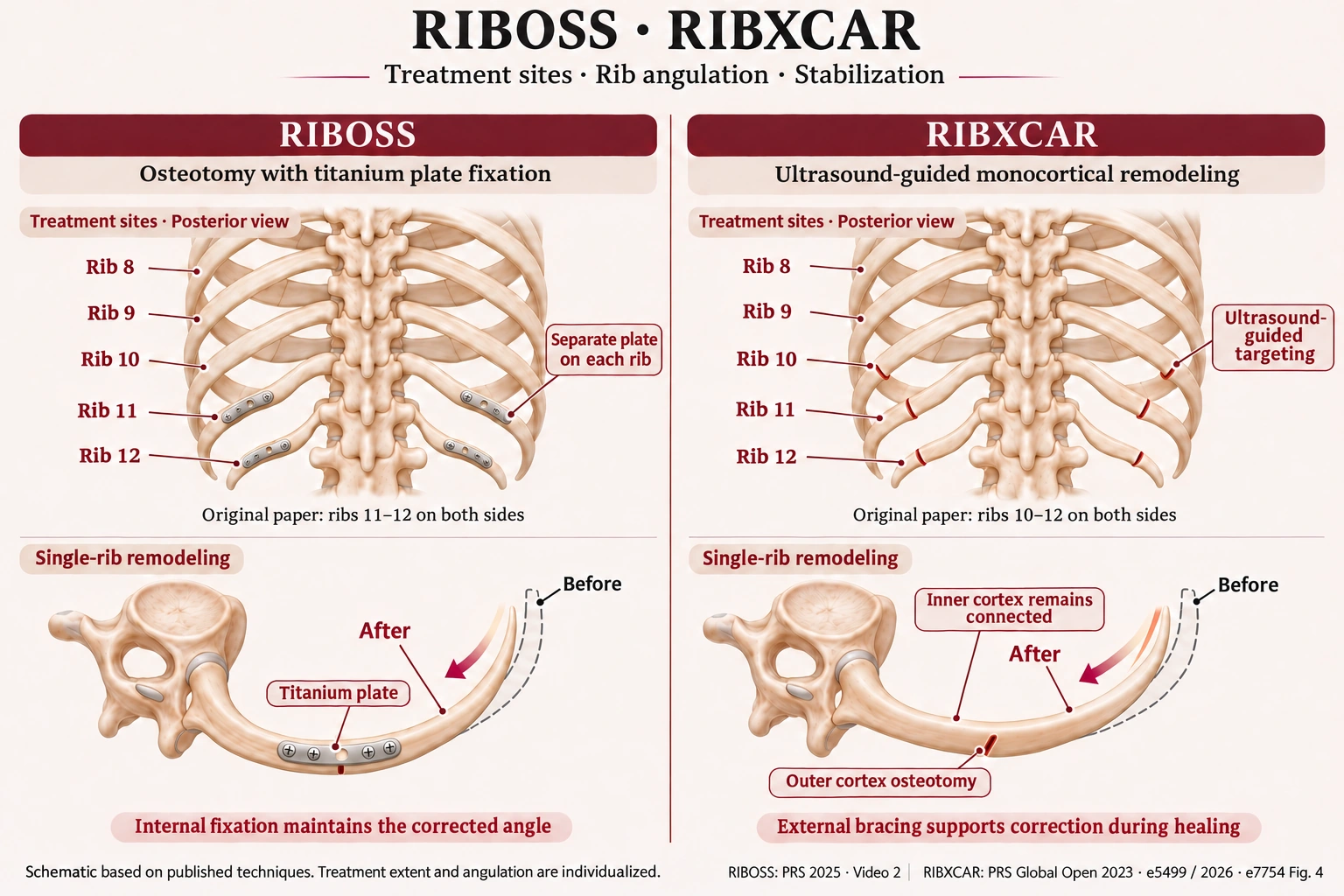
The diagram shows inward rib angulation and the difference between internal plate fixation and support from an external brace.
Rib numbers reflect the original papers. The extent and angle of correction are tailored to each patient.
View larger diagramDiagram references: RIBOSS · 2025 · Video 2 · RIBXCAR · 2023 · RIBXCAR · 2026 · Fig. 4
| What to consider | RIBOSS · Titanium plate fixation | RIBXCAR · Ultrasound-guided percutaneous remodeling |
|---|---|---|
| How the rib is treated | The rib is retained. A limited osteotomy changes its angle, which is then secured with a titanium plate and screws. | Under ultrasound guidance, one cortex is divided and the angle adjusted while retaining the connection on the opposite side. |
| Access and scars | A skin incision is needed to reach the rib and position the plate. The resulting scar is part of the discussion. | Instruments enter through skin punctures. Even small access sites can sustain skin injury or leave scars. |
| Maintaining the corrected angle | An implanted plate provides internal fixation, reducing reliance on a corset for bone stabilization. Compression garments for any combined procedures are planned separately. | No metal plate is implanted. An external brace is an important part of care while the bone heals. How and how long to wear it is individually advised. |
| What to monitor during recovery | The incision, implant-related discomfort, pain and bone healing are assessed. The implications of leaving fixation hardware in the body are discussed. | Brace use, pressure on the skin, pain, maintenance of correction and bone healing are assessed. Discuss whether the care plan fits daily life. |
Advantages and considerations
| What to consider | RIBOSS · Titanium plate fixation | RIBXCAR · Ultrasound-guided percutaneous remodeling |
|---|---|---|
| Advantages | Internal plate fixation can reduce reliance on an external brace for bone stabilization. | Access is through small skin punctures, without implanting a metal plate. |
| Disadvantages and burdens | Skin incisions, scars and the presence of metal fixation hardware in the body need to be considered. Compression garments may still be needed for combined procedures. | Brace use and activity management are important. Even small access sites can develop skin injury, burns or scars. |
An advantage of a procedure may not be an advantage for you.
We plan treatment and recovery together, considering your chest-wall anatomy, desired changes, views on scars and implants, and how brace use would fit your daily life.
Which approach might suit me?
- Chest-wall anatomy and healthRib shape, bone quality, surrounding tissues, respiratory conditions and previous surgery are assessed. One finding does not determine the technique; surgery itself may be unsuitable.
- Desired change and acceptable burdensDiscuss the area and extent of correction, your views on incision scars and metal implants, and the burden of wearing a brace.
- Recovery and everyday lifeWork, activity, combined procedures, brace care and access to follow-up are considered. Recovery planning is individualized alongside the operation.
At da Re-Fit Clinic, we consider your chest-wall anatomy and goals alongside wounds, discomfort and the return to daily life. During consultation, we explain each method’s advantages, burdens and individual risks, then agree on an operation and recovery plan suited to you.
Both are operations on the ribs. Risks including pain, bleeding, infection, pneumothorax, hemothorax and asymmetry must be considered, along with individual differences in recovery.
Scars, braces and recovery: common questions
At da Re-Fit Clinic, we plan for wound care, comfort and your return to daily life. These are the principles we use to guide patients through scar care, brace use and recovery.
How do scars differ between RIBOSS and RIBXCAR?
Before surgery, we explain the expected location and extent of wounds and how to care for them during recovery. RIBOSS requires a skin incision to position the plate; RIBXCAR uses small skin punctures. Even small access sites can develop skin injury, burns or scars, so we assess the wounds after surgery and guide your care accordingly.
Does RIBOSS mean I will not need a brace or compression garment?
RIBOSS fixes the ribs internally with plates. We distinguish a brace for bone stabilization from compression garments needed for combined procedures such as liposuction. We review the extent of your operation and any combined procedures, then advise whether support is needed and for how long.
How long is a brace worn after RIBXCAR?
We tailor brace wear time and pressure to the extent of surgery and bone healing. We explain how to wear it and what to consider in daily life, adjusting the plan as recovery progresses. If you develop pressure-related skin discomfort or pain, contact the clinic instead of enduring it or tightening the brace further. We also confirm together when to reduce or stop wearing it.
How many days after surgery can I return to work or daily life?
At consultation, we ask about your work, usual activity and preferred return date to plan your recovery. Desk work and heavy lifting require different levels of recovery. After surgery, we assess pain, wounds, breathing, combined procedures and practical brace use before advising when to return.
When can I resume exercise or strenuous activity?
We guide a gradual return, distinguishing light daily activity from strenuous exercise. We advise resuming heavy lifting or exercises that strongly engage the trunk after assessing the surgical site and bone healing. We consider more than pain relief alone and adjust activity type and intensity to your operation and progress.
Is recovery faster with RIBOSS or RIBXCAR?
Recovery time depends on the extent of surgery, combined procedures, health and daily circumstances. We consider the recovery demands of the incision and implants with RIBOSS and brace use with RIBXCAR. We listen to your concerns and return-to-activity goals, then agree on a suitable operation and care plan.
Sources for the technique descriptions
- Aguilar Villa et al. Aesthetic Rib Cage Remodeling with Osteosynthesis. Plast Reconstr Surg. 2025;155:279–288.
- Manzaneda Cipriani et al. Waist Remodeling without Incision, with Ultrasound-guided Monocortical Fracture. PRS Global Open. 2023;11:e5499.
- Ramírez Donders and Ramirez Saenz. Waist Remodeling Without Incision, With Ultrasound-guided Monocortical Fracture: Report of 220 Patients. PRS Global Open. 2025;13:e6595.
Who may be suitable?
Factors in assessing suitability
We first determine whether fat, skin and the abdominal wall, or the skeleton mainly shapes the waistline. An unchanged waist after weight loss does not necessarily implicate the ribs. Each contributing structure calls for an appropriate approach.
→ When Weight Loss Does Not Change Your Waistline: Fat, Abdominal Wall and Rib Cage
Preoperative assessment
3D chest CT checks rib number, length and cartilage connections and is required before surgery. It shows anatomy, but cannot predict how much waist circumference will change.
Anatomical limits
Rib flare requires different approaches depending on where the prominence lies. Lower-rib shaft direction may overlap with RIBXCAR’s target, but anterior cartilage or costal-margin prominence involves a different region and approach. Examination and CT distinguish them.
When surgery is difficult to recommend
- Osteoporosis, osteopenia or other metabolic bone disease
- History of rib fracture
- Asthma, COPD or other respiratory disease
- Connective-tissue disease, including Marfan and Ehlers–Danlos syndromes
- Chest-wall deformities that have not been assessed, including pectus excavatum and pectus carinatum
- Long-term steroid use
- Pregnancy, breastfeeding or plans for pregnancy soon
- Difficulty attending scheduled follow-up
If expectations differ from what is possible, technically successful surgery may still be disappointing. We discuss that gap during consultation.
→ All situations in which surgery is not recommended
Risks and complications of RIBXCAR
An incomplete fracture does not guarantee fast recovery or freedom from complications. The list below includes complications reported after ultrasound-guided operations.
Pain
Irritation or injury of the intercostal nerve along the lower rib edge can cause persistent pain. Chronic pain may also follow breakage of the inner cortex or failure of bone union.4
Pneumothorax and hemothorax
Pleural injury may allow air into the pleural space and partially collapse the lung. A study of 3,805 patients from 8 countries reported 4 pneumothoraces and 1 hemothorax.4 In an international survey of 2,351 patients undergoing various rib-remodeling methods, pneumothorax occurred in 0.17%, all reported with RIBXCAR.11
Nerve and vessel injury
The vein, artery and nerve run together in the groove beneath the rib. Intercostal nerve injury may cause stabbing or burning pain, tingling or reduced sensation, typically in a band along the rib. Recovery can take months and may be incomplete.
Problems with rib healing
- Bicortical fracture involving the inner cortex45
- Nonunion (pseudarthrosis): 15.1% of complications among the 86 affected patients (3.7%) in the international survey11
- Unplanned rib fracture
- Loss of correction: in the 2021 open-incision study, 3 patients who did not follow corset instructions underwent repeat surgery2
Other known complications
Costochondritis, subcutaneous emphysema, atelectasis, pneumonia, infection, asymmetry and dissatisfaction with shape may occur. Their symptoms, timing and management are described in Risks and Safety.
Safety remains under discussion
Journal correspondence is debating whether perpendicular access to the rib or osteotomy parallel to the cortex is safer. No conclusion has been reached. Evidence in this field is still accumulating.
RIBXCAR and respiratory function
Chest movement during breathing
The rib cage is not a fixed container. During inhalation, ribs rotate at their spinal joints, rising upward and outward. The diaphragm, intercostal muscles, abdominal wall and chest work together as a system.
Lower ribs and breathing
Abdominal muscles attach to ribs 11 and 12, stabilising the chest and spine and contributing to expiratory force.8 It is incorrect to say that the lower ribs have no role in breathing.
Published lung-function study
In a study testing 294 women aged 18–38 before surgery, at 6 months and at 1 year, lung-function measurements showed no significant change.7 Among 179 patients receiving RIBXCAR alone, FEV1 was 3.03 → 3.02 → 3.04 L and FVC was 3.26 → 3.25 → 3.25 L. Among 115 also undergoing conversion of rib 10, FEV1 was 3.02 → 3.02 → 3.04 L and FVC was 3.25 → 3.24 → 3.27 L.
A study comparing 11 women who had ribs 11 and 12 removed with 11 nonsurgical women found lower FEV1 and expiratory muscle strength in the surgical group.8 Those findings concern rib resection, not RIBXCAR. No study has directly compared the two operations.
Study limitations
- The lung-function study was conducted at one centre by the technique’s developers, without a nonsurgical control group.
- Only young women without lung disease were included, with one year of follow-up.
- Breathing during strenuous exercise and respiratory muscle strength were not measured.
- People with a history of obstructive or restrictive lung disease were excluded. This is why the operation is not recommended for those with asthma, COPD or other respiratory disease.
→ Rib surgery and respiratory function
→ How breathing works
Recovery after RIBXCAR
The recovery process
Chest-wall shape is not final immediately after surgery. Tissue adaptation and resolution of swelling take weeks to months. Bone heals through hematoma, soft callus and hard callus before remodeling over several months. Less pain does not mean this process is complete.
Binder use
Until it heals, the bent rib remains subject to the pull of attached muscles.4 A binder helps the bone unite at its changed angle. Wearing periods vary: the 2021 study required at least 2 months,2 and the 3,805-patient study recommended at least 3 months.4 There is no single fixed standard; duration depends on the extent of surgery and recovery.
Returning to daily activities
The technique, extent and recovery vary between individuals. Advice on resuming activities is provided after assessment.
Precautions
Severe pain and shallow breathing increase the risk of atelectasis and pneumonia. Adequate pain control and deep-breathing exercises are important. Symptoms requiring contact, such as sudden chest pain or breathlessness, are listed in Risks and Safety.
Follow-up
Progress is checked on a planned schedule with repeat measurements and imaging. Postoperative CT is not routine; it is used for indications such as persistent pain or suspected nonunion. If scheduled follow-up is difficult, it is better to postpone surgery.
→ Bone healing and CT after surgery
Clarify costs and follow-up together
Which items should I check when discussing the cost of RIBXCAR?
Check consultation and tests, surgery, anaesthesia and recovery observation, the binder, and planned follow-up separately. Distinguish included items from possible charges for additional tests or visits, and ask for an updated estimate if the surgical plan changes. A total price alone does not tell you whether examination and follow-up cover the same things. Ask for an explanation based on your proposed plan.
What should I report if the binder is uncomfortable or asymmetry or pain persists?
Note the surgery date and area, when the problem began, the location of pain or skin changes, and what is difficult about wearing the binder. Prepare previous operation records and images if available. Follow-up assesses your current condition and whether further tests are needed; photographs alone cannot confirm bone union or the final contour. Confirm your individual instructions for binder type, fit, duration and the next check.
How should I plan surgery and return travel when visiting from another city or country?
Tell us your available dates, possible length of stay, return transport and companion arrangements. Plan consultation and tests, preparation and recovery observation if surgery is chosen, and checks before departure and afterwards as separate stages. A consultation booking does not confirm surgery, and flying or returning to work cannot be scheduled from the operation date alone. Before leaving, confirm binder instructions, the next visit, relevant treatment records and contact arrangements.
- Travel and follow-up preparation →
- Consultation during hormone therapy →
- Recovery and return to work →
Medical research on RIBXCAR
The table summarises published research, not outcomes at da Re-Fit Clinic. Study figures are averages; individual results vary.
| Study | Participants | Main findings | and Limitations |
|---|---|---|---|
| 2023 · First report1 | 30 patients | Ultrasound measurements before surgery, immediately afterwards, and at 1 and 3 months assessed maintenance of the angle change. | 30 patients followed for up to 3 months. |
| 2024 · Intraoperative assessment3 | 100 patients | A cracking sound was heard in only 90 patients, but immediate ultrasound confirmed a monocortical fracture in all 100. | Examined immediate confirmation of the procedure. |
| 2026 · Multicenter cohort4 | 3,805 patients in 8 countries; 1-year follow-up | Angles of ribs 10–12 decreased by an average of 10 degrees. Reported complications included 4 pneumothoraces, 1 hemothorax, bicortical fractures and chronic pain from pseudarthrosis. | Led by the technique’s developers, with one year of follow-up. |
| 2026 · Lung function7 | 294 women aged 18–38 (179 RIBXCAR alone; 115 with conversion of rib 10) | FEV1 and FVC did not differ significantly between baseline, 6 months and 1 year. | Single-centre study without a control group, limited to young women without lung disease. |
| 2026 · Osteotomy experiment5 | 50 pig ribs | Perpendicular osteotomy produced monocortical fracture at an average of 6.67 newtons and bicortical fracture at 10.0 newtons. | Ex vivo animal-bone findings cannot be directly applied to human surgery. |
| 2026 · Osteotomy direction comparison6 | 240 patients | Recurrence was defined as increasing waist circumference during follow-up; rates differed by osteotomy direction. | Compared osteotomy directions, not different operations. |
| Meta-analysis9 | 4 studies, 318 patients; rib remodeling without rib removal | Average waist reduction of 8.6 cm at 3 months, with no reported pneumothorax or hemothorax. | No control groups; most participants also had procedures such as liposuction. Maximum follow-up ranged from 3–12 months, and one co-author developed RIBXCAR. |
| 2025 · Systematic review10 | 12 studies of rib resection and remodeling | Risks including pneumothorax and chronic pain were reported with resection; fewer complications were reported with newer remodeling methods. | The authors concluded that lack of long-term and randomised comparative studies prevented definitive conclusions about effectiveness and safety. |
| 2026 · International survey11 | 2,351 patients treated with various rib-remodeling methods | Complications occurred in 86 patients (3.7%); 15.1% of those complications involved nonunion. Pneumothorax occurred in 0.17%, all reported with RIBXCAR. | Survey combining several techniques. |
| 2024 · Lung function after rib resection8 | 11 women with ribs 11 and 12 removed; 11 nonsurgical women | FEV1 and expiratory muscle strength were lower in the surgical group. | Study of rib resection, not RIBXCAR. Small groups of 11, with no preoperative tests. |
Overall, controlled studies and follow-up beyond one year are limited. Evidence for cosmetic rib remodeling is still developing.
Frequently asked questions about RIBXCAR
What is RIBXCAR?
RIBXCAR is a method of rib remodeling that changes lower-rib angles without removing the ribs, to alter the skeletal contour of the upper waist. A fine instrument is inserted through the skin instead of an incision, and only the outer cortex is divided under ultrasound guidance. It is not an operation to remove fat.
How does RIBXCAR work?
Only the outer cortex at the back of the lower rib is divided. The rib bends inward while the inner cortex remains connected. This incomplete, or greenstick, fracture does not separate the bone into two pieces. A binder helps it unite at the changed angle.
How does RIBXCAR differ from rib resection?
Rib resection removes part of a rib. RIBXCAR retains the rib and changes its angle. Removed tissue does not return. However, operations that keep ribs also carry risks, and safety cannot be judged by removal alone.
Are RIBXCAR and rib remodeling the same?
Rib remodeling is the general term for changing rib angles while retaining the bone. RIBXCAR is the name of an incision-free, ultrasound-guided method within that category. da Re-Fit Clinic offers both RIBOSS with titanium plate fixation and RIBXCAR, selecting the approach according to the individual patient.
Can RIBXCAR affect breathing?
In a study of 294 women aged 18–38 tested before surgery, at 6 months and at 1 year, lung-function measurements did not differ significantly from baseline. However, it was a single-centre study by the developers, without a control group, limited to young women without lung disease and one year of follow-up. Chest-wall complications such as pneumothorax may occur soon after surgery.
What are the risks of RIBXCAR?
Possible complications include pneumothorax, hemothorax, pain from intercostal nerve injury, unplanned rib fracture, bicortical fracture involving the inner cortex, nonunion, infection and asymmetry. A study following 3,805 patients from 8 countries for one year reported 4 pneumothoraces and 1 hemothorax.
How do ribs heal after RIBXCAR?
An incomplete fracture is intentionally created, so the bone must unite again. Healing progresses through hematoma, soft callus and hard callus, with remodeling over several months. Less pain does not mean this process is complete.
Can anyone have RIBXCAR?
No. Metabolic bone disease such as osteoporosis, previous rib fractures, respiratory disease such as asthma or COPD, and connective-tissue disorders may rule out surgery or require further testing first. With a chest-wall deformity such as pectus excavatum or carinatum, assessment as a chest-wall deformity comes first, and suitability is then judged separately. We do not proceed if assessment indicates it is unsuitable.
Why is a binder used after RIBXCAR?
Until it unites, the bent rib remains subject to muscular traction. A binder helps it heal at the changed angle. Reported periods vary—at least 2 months or at least 3 months, for example—and are chosen according to the extent of surgery and recovery.
Can I have a RIBXCAR consultation in Korea?
At da Re-Fit Clinic (162 Apgujeong-ro, Gangnam-gu, Seoul), a board-certified cardiothoracic surgeon provides RIBXCAR consultations and surgery. Telephone inquiries are accepted; consultation does not necessarily lead to surgery.
What expertise should I ask about before RIBXCAR?
Check whether the clinician understands the pleura, lungs, intercostal nerves and vessels beneath the ribs and can recognise and manage complications such as pneumothorax. Ask about preoperative 3D CT, how fracture shape and union are assessed during and after surgery, and management of bicortical fracture or nonunion.
Are there medical publications on RIBXCAR?
Yes. Since the first report of 30 patients in 2023, publications include a 3,805-patient multicenter cohort, a lung-function study of 294 patients and a meta-analysis of 4 studies involving 318 patients. Most lack control groups, follow-up is generally no longer than one year, and many involve the developers.
Surgeon and clinic information
Surgeon
- Dongju Seo — Board-certified cardiothoracic surgeon, Director of da Re-Fit Clinic
- Formerly at the Department of Cardiothoracic and Vascular Surgery, Asan Medical Center
- Training at Massachusetts General Hospital (MGH)
- Member, Korean Society for Thoracic and Cardiovascular Surgery
→ Qualifications, experience and clinical principles
→ Clinic physician profile: publications and conference presentations
Clinic
- da Re-Fit Clinic · Thoracic Surgery
- 4F, 162 Apgujeong-ro, Gangnam-gu, Seoul, Republic of Korea
Consultation inquiries are accepted by telephone. Consultation may not lead to surgery; that is also a valid outcome.
About this article
- Korean original written and medically reviewed by Dongju Seo, board-certified cardiothoracic surgeon (da Re-Fit Clinic)
- Written October 9, 2026 · Last reviewed October 9, 2026
- This medical information summarises published research and clinical criteria and does not replace individual diagnosis or treatment.
References
- Manzaneda Cipriani RM, Duran Vega H, Cala Uribe L, et al. Waist Remodeling without Incision, with Ultrasound-guided Monocortical Fracture. Plast Reconstr Surg Glob Open. 2023;11(12):e5499. doi:10.1097/GOX.0000000000005499 · PubMed 38115833
- Kudzaev KU, Kraiushkin IA. Waist Narrowing without Removal of Ribs. Plast Reconstr Surg Glob Open. 2021;9(7):e3680. doi:10.1097/GOX.0000000000003680 · PubMed 34262840
- Manzaneda Cipriani RM. Is “Clack” Enough? Rib Remodeling Guided by Ultrasound. Plast Reconstr Surg Glob Open. 2024;12(5):e5843. doi:10.1097/GOX.0000000000005843 · PubMed 38784832
- Manzaneda Cipriani RM, Duran H, Adrianzen GA, et al. A Multicenter Cohort Study of 3805 RibXcar Cases: Safety and Efficacy in Incisionless Rib Remodeling. Plast Reconstr Surg Glob Open. 2026;14(7):e7929. doi:10.1097/GOX.0000000000007929 · PubMed 42460035
- Manzaneda Cipriani RM, Duran H, Adrianzen GA, et al. RibXcar with Dots Point Technique: The Science of Fracture as a Safety Principle. Plast Reconstr Surg Glob Open. 2026;14(6):e7816. doi:10.1097/GOX.0000000000007816 · PubMed 42293807
- Manzaneda Cipriani R, Vega HD, Flores E, et al. Scarless Rib Reshaping: Comparison of Straight and Oblique Approaches in Terms of Efficacy and Recurrence. Plast Reconstr Surg Glob Open. 2026;14(5):e7697. doi:10.1097/GOX.0000000000007697 · PubMed 42221283
- Manzaneda Cipriani RM, Adrianzen GA. Respiratory Function Assessment After Waist Reduction Through Scarless Ultrasound-Guided Monocortical Fracture (RibXcar) Surgery for Body Contouring. Aesthet Surg J Open Forum. 2026;8:ojag007. doi:10.1093/asjof/ojag007 · PubMed 42022463
- Aburub A, Darabseh MZ, Badran R, et al. Ant-waist surgery adversely affects lung function: a cross-sectional study. Multidiscip Respir Med. 2024;19(1):984. doi:10.5826/mrm.2024.984 · PubMed 39093016
- Milani-Reis A, Roca Mora MM, Bicudo Bregion P, et al. Rib Remodeling Without Rib Resection: A Systematic Review and Meta-analysis. Aesthetic Plast Surg. 2026;50(2):667-674. doi:10.1007/s00266-025-05240-w · PubMed 41003707
- Ferreira LM, Bonin GS, Bernardes ABS, et al. Is There Scientific Evidence on the Practice of Rib Resection or Remodeling for Body Contouring Purposes?—A Systematic Review. Aesthetic Plast Surg. 2025;49(7):2007-2014. doi:10.1007/s00266-025-04685-3 · PubMed 39838130
- Aguilar HA, Hoyos AE, Ramirez B, et al. Global Survey on Rib Remodeling Techniques: Assessing Complications and Safety in Waistline Contouring. Plast Reconstr Surg Glob Open. 2026;14(4):e7609. doi:10.1097/GOX.0000000000007609 · PubMed 41983160
Rib remodeling is an elective cosmetic operation. Suitability and outcomes vary with individual anatomy and health. A decision should follow examination, testing and a thorough discussion with the medical team.